Here and Now
Tom Content on Data Center Energy Use and Utility Ratepayers
Clip: Season 2400 Episode 2442 | 5m 39sVideo has Closed Captions
Tom Content on an electricity rate plan to shield customers from data center costs.
Citizens Utility Board Executive Director Tom Content discusses the Public Service Commission of Wisconsin setting an electricity rate plan for We Energies to shield customers from data center costs.
Problems playing video? | Closed Captioning Feedback
Problems playing video? | Closed Captioning Feedback
Here and Now is a local public television program presented by PBS Wisconsin
Here and Now
Tom Content on Data Center Energy Use and Utility Ratepayers
Clip: Season 2400 Episode 2442 | 5m 39sVideo has Closed Captions
Citizens Utility Board Executive Director Tom Content discusses the Public Service Commission of Wisconsin setting an electricity rate plan for We Energies to shield customers from data center costs.
Problems playing video? | Closed Captioning Feedback
How to Watch Here and Now
Here and Now is available to stream on pbs.org and the free PBS App, available on iPhone, Apple TV, Android TV, Android smartphones, Amazon Fire TV, Amazon Fire Tablet, Roku, Samsung Smart TV, LG TV, and Vizio.
Providing Support for PBS.org
Learn Moreabout PBS online sponsorshipsituation?
Will they be more moderate, more kind of aligned with national Democrats?
And so I think we're seeing that fight kind of play out or tension play out in a lot of these primaries.
projection shows Wisconsin will lose more than $2 billion in sales tax revenue because of an exemption written into the 2325 state budget for data centers, a break designed to promote economic development.
Three years later, the state is swimming in new data centers with consumer concerns about water and energy usage.
But in a win for consumers, the Wisconsin Public Service Commission just ruled that existing electricity customers should not pay a single cent to subsidize the service of data centers.
The ruling is also a major win for the Citizens Utility Board, which fought on behalf of customers.
Executive director of Cub Tom Content joins us now with more.
And thanks very much for being here.
>> Oh, great to be with you.
>> So you've said that this case was the most significant one the cub has ever been involved in.
So when the PSC ruled, what was your reaction?
>> I was I was frankly surprised.
I, I've had a good feeling that we were going to get some of what we asked for in terms of significant changes to what the proposal was.
But we got the vast majority of our changes or changes that addressed our concerns.
They really the commissioner really sent a message, even though they can't control every cent, they sent a message that every dollar needs to be accounted for and every.
As they, as one of the commissioners put it, every every cent should be paid for by the tech companies.
>> So how does the proliferation of data centers in Wisconsin engage consumers in a way that other rate cases may not have?
>> It's it's I think I think it's a combination of fear of concerns about rising energy costs, because we've already come into this period with rising energy costs that have risen at rates higher than inflation, paired with the the local community reaction.
And and basically the Wisconsin reaction, as noted in the Marquette polls to data centers.
And, you know, the the Marquette poll that just came out showed a lot more clarity about where Wisconsinites stand about data centers than it showed about who's running for governor.
And they they by a 2 to 1 margin, people said that the cost of data centers outweigh the benefits.
And I think I think layered into that is, is fear of AI and, and what it's what what the the impacts of AI are on the economy and society down the road.
I think that plays into it.
>> Too, because I understand that thousands of people kind of came to Cub and said, yes, we we want the PSC to rule in this way.
>> Thousands of people went to the PSC hearings or PSC hearings or submitted comments online.
And so those could have been people in Milwaukee, people around the state, we energies customers and others.
I mean, frankly, the tech companies and the utility were saying the right things all along that they were going to meet their demand or that they were going to play their own way.
But for us, the devil was always in the details, and we found some loopholes and just areas of concern where we thought the risks that customers were still going to be on the hook were too, too high with what was what was what was the proposal was.
>> So does does the ruling mean that power company customers will not be on the hook at all for the giant energy needs of these data centers?
>> They went as far as they could.
They ran into a couple areas where they couldn't go as far as they wanted, because certain things were out of the state's control.
And what I mean by that is if if people may have seen that at the white House, the tech companies were at the white House pledging to pay their own way and signed a ratepayer protection pledge.
Now, that was more of a, you know, an optics document, a a rhetoric document.
And it was non-binding, but it actually committed the tech companies to pay their way for all the network upgrades, which which to us sounds like the power lines, right.
And the big power lines.
And the fact is, our power line company, American transmission billion of infrastructure to feed these data centers, is actually regulated out in Washington, D.C.
So the state Public Service Commission couldn't change that.
And so as a result, the the the commissioner sent a message that they could only go so far, but they called on HTC and the We Energy's parent company to make changes that would protect customers from, frankly, billions of extra costs tied to these projects.
>> What else stood out for you from the PSC on this case?
>> I think what stood out is, is that the the.
The fact that the data centers will be on the hook for 100% of the new power plants.
There was one scenario where other customers, small businesses, homeowners, renters would be on and other businesses would be on the hook for up to 25% of the cost of new power plants.
And that's not a small number.
We energies has already gotten approval for over almost 2 billion in projects and has another 6 billion in the queue.
So a quarter of that, a quarter of that would have been a couple billion dollars on the hook that customers would have been responsible for.
So.
So that was a big the biggest change and one that we really appreciated.
>> All right.
Well, we appreciate you joining us appreciate you joining us
 New
NewAnimal Rights Groups Push to End Biomedical Testing on Dogs
Video has Closed Captions
Clip: S2400 Ep2442 | 1m 21s | Two animal rights groups announce a deal to buy nearly 1,500 beagles from Ridglan Farms. (1m 21s)
 New
NewHere & Now opening for May 1, 2026
Video has Closed Captions
Clip: S2400 Ep2442 | 1m 12s | The introduction to the May 1, 2026 episode of Here & Now. (1m 12s)
 New
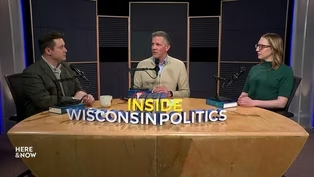
NewInside Wisconsin Politics: Many Democratic Primaries in 2026
Video has Closed Captions
Clip: S2400 Ep2442 | 5m 39s | Inside Wisconsin Politics on why so many Democrats are running in 2026 primaries. (5m 39s)
 New
NewPaul Hutson on Potential for Psychedelics in Mental Health
Video has Closed Captions
Clip: S2400 Ep2442 | 7m 9s | Paul Hutson on how psilocybin is used in clinical settings to treat mental health issues. (7m 9s)
 New
NewPolitical Violence and Wisconsin's 2026 Race for Governor
Video has Closed Captions
Clip: S2400 Ep2442 | 4m 57s | Candidates in the 2026 race for governor on political violence and their personal safety. (4m 57s)
Providing Support for PBS.org
Learn Moreabout PBS online sponsorship
- News and Public Affairs

Top journalists deliver compelling original analysis of the hour's headlines.

- News and Public Affairs

Today's top journalists discuss Washington's current political events and public affairs.












Support for PBS provided by:
Here and Now is a local public television program presented by PBS Wisconsin