
Outpriced and Overlooked
Episode 30 | 26m 46sVideo has Closed Captions
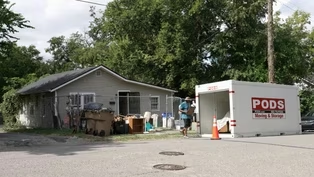
Older Nashvillians are being priced out of the places they've called home.
Across the country, older adults are being priced out of the places they’ve called home. Rents are rising, affordable housing options are shrinking, and the safety net meant to protect aging Americans is failing. In this story, we meet older adults facing impossible housing costs — and the people trying to help — to understand how we got here, and why the solutions we have aren’t enough.
Problems playing video? | Closed Captioning Feedback
Problems playing video? | Closed Captioning Feedback
Aging Matters is a local public television program presented by WNPT
Outpriced and Overlooked
Episode 30 | 26m 46sVideo has Closed Captions
Across the country, older adults are being priced out of the places they’ve called home. Rents are rising, affordable housing options are shrinking, and the safety net meant to protect aging Americans is failing. In this story, we meet older adults facing impossible housing costs — and the people trying to help — to understand how we got here, and why the solutions we have aren’t enough.
Problems playing video? | Closed Captioning Feedback
How to Watch Aging Matters
Aging Matters is available to stream on pbs.org and the free PBS App, available on iPhone, Apple TV, Android TV, Android smartphones, Amazon Fire TV, Amazon Fire Tablet, Roku, Samsung Smart TV, and Vizio.
Providing Support for PBS.org
Learn Moreabout PBS online sponsorship(gentle music) (tape whirs) (tape rips) - I'm glad we got to this point.
Now, our home's gonna look so much better.
(gentle music) (tape clacks) (hand swishes) (camera shutters) (gentle music) (gentle music continues) - Who's that?
- And this neighbor, they used to live across the street.
Little Lee, they used to come by, and they had a bush out there with birds.
Little Lee would come by and just flush out the birds.
At that time, we all had lawn chairs sitting out behind.
We had the little bush.
- Mm-hmm.
- [Elaine] And no one knew we was out there, but the whole family had a lawn chair, and we were sitting out there just enjoying the summer bridge.
- Sure did.
As always, I felt safe here.
Oh, I loved this being our home.
It's small, but it was a lot of love.
(gentle music) - [Presenter] Major funding for "Aging Matters" is provided by the West End Home Foundation, advancing aging with dignity and strengthening communities through strategic grant-making, policy advocacy, and cross-sector collaboration.
The Jeanette Travis Foundation, dedicated to improving the health and well-being of the Middle Tennessee Community, and the HCA Healthcare Foundation.
(bright music) (paper rustling) - [Angela] I fiddle too long.
(laughs) e It is amazing, I don't even know where he can go to.
- [Angela] I was looking for that.
- [Narrator] Elaine Wilson has lived in this house since the 1980s.
Over the decades, she and her late husband raised a family and bundled together a lifetime of memories in their small but ample home.
It's where her daughter Angela and her siblings grew up.
But the grinding of years and a lack of resources left their family home in a state of gradual disrepair.
- You are splitting or dividing what you have with practically nothing.
(laughs) Because everything seemed to, you know, come at the same time that the bill gotta be paid.
So, you're dividing everything.
Since I retired, the hardest is not being able to do what I could do and then take me no time when I could do it.
(homeware clattering) I have reached that age where it is time for me to sit back and enjoy all, you know, what I have done for those 20-some years.
And just enjoy the company of my family.
That's what I miss the most.
(gentle music) Spending that time, having that time with them.
- You want to be able to invite people over and not feel like, you know, "Okay, I gotta fix this."
And that's why a lot of people don't come around as much as possible 'cause it's not as comfortable for them as well as for you.
- See, y'all supposed to got the gallon trash bags.
- Yeah, well- - Now this turn... - We got what we get.
(laughs) Try to step in and help her as much as possible.
And then you still need more help than that.
It just seems like it's continually, you just need more help to get things done.
So like I said, we're just thankful for everything that's being done now.
- I know, perfect.
(homeware rattling) Oh, got one of those.
In visiting her home, and talking with Ms.
Wilson, it's clear that her home is really a place of like safety, and love, and just good memories.
(gentle music) (everybody frolicking) - [Narrator] Andrea Prince is the CEO at Rebuilding Together Nashville.
What started as a volunteer operation focused on home repairs and disaster recovery, has now become a full-time business.
- So, in working in disaster recovery, that has transformed over time into really addressing the manmade disaster that's happening here in Nashville.
And that's the lack of affordable housing.
So much gentrification is happening here in the city.
More and more homeowners are feeling the pressure to sell.
And so, really, what preservation can do is help keep long-term residents in their homes.
97% of our homeowners that we work with are all over 60.
And looking at the neighborhoods that we serve, you know, we intentionally work in neighborhoods that have been historically under-resourced and have been underserved in the past.
- [Narrator] And what will that mean for Elaine Wilson?
(drill zooms and whirs) - [Andrea] We're gonna be repairing her bathroom.
As you've seen, her sink is hanging on by a thread.
She needs a really safe toilet that she can get on and off of, a tub, a shower to be able to, you know, bathe, simple things.
Her kitchen, you know, her cabinets are coming off the wall, so making sure that she has safe cabinets and accessibility around her kitchen.
Flooring throughout the home.
And then the biggest thing is, you know, looking at that drywall and ceiling repair.
She's been living with a hole in her ceiling for years.
- [Elaine] We got the repairs, things would need to function here, and it is definitely needed just when, you know, affordable enough for me to be able to get it done.
(shovel scraping) I wanted this, and I'm sure my husband was alive, he wanted this, too.
We all wanted it, you know, to get the repairs.
But not being able to afford it is a whole different story.
- The important piece to preservation is how we can help keep affordable houses that already exist on the market.
You know, we, on average, invest around $24,000 per home that we're working in.
You know, you preserve a dozen homes for one affordable home that you can build, and you can do it a lot faster we're shovel-ready.
I think the other really great benefit is that the money is going directly back to longtime residents who have paid their property taxes, who have been, you know, members of this community, and they deserve it.
- Good morning, I'm the Metropolitan Trustee.
It's good to see each of you here this morning.
When we think about those that are 65 years or older, they're usually retired.
So we know, most of the times, that their income is not increasing, and as we know, everything is rising.
Whether it's property taxes, inflation, tariffs, you name it.
- [Narrator] Erica Gilmore is the Metropolitan Trustee for Nashville and Davidson County.
In addition to tax collection, her office also administers the Property Tax Freeze and Property Tax Relief programs for those who qualify.
- [Erica] Property Tax Freeze and Property Tax Relief programs are a way for our disabled veterans that are 100% connected, and our seniors, and those that are disabled to get relief on their property taxes.
For the Property Tax Relief program, it reduces property tax payments through State and Metro-funded credits, and it offers benefits with no repayment required and no risk of debt.
For a Property Tax Freeze, it eliminates the burden of future property taxes by locking in the same tax payment amount going forward.
Oh, okay.
- I never know what to do.
- Well, I came out here today because I've lived in Nashville since I was 10 years old.
I'm 72, love this town.
I own my own home.
I just retired from working.
And those of us who rely on Social Security as our main source of income, you have to do what's right for you to get through to the next period.
I think it's apropos for those who have worked all their life, paid taxes all their life, and are now trying to live a happy retirement.
Be free of the fear of, "Oh my gosh, am I gonna lose my house?
Am I gonna lose everything?"
- These are persons that have invested in our community.
We need to give them a break.
And this allows them to age in place respectfully and with dignity.
- [Narrator] While maintaining home ownership is not without challenges, it's long been a metric of both success and stability, yet it remains out of reach for many working-class Americans.
The alternative is renting.
And according to Linna Zhu, a Housing Policy Expert at the Urban Institute, senior renters are especially burdened by the high cost of housing.
- [Linna] Being cost-burdened means the housing costs are eating up too much of your income, leaving very little resources for other essentials.
For example, food, medication, and transportation.
So when we say a household is housing cost-burdened, they are paying more than 30% of their household income on housing costs.
And if the ratio is above 50%, we define this type of household as severely cost-burdened household.
So we find that 26% of rent, senior renters, are cost-burdened, and another 35% are severely cost-burdened, indicating there's more than 60% of renters in total are constrained by this causing cost-burden.
- [Narrator] According to Zhu, the ultimate cost of housing insecurity is far greater and more prevalent than one might imagine.
- Renters are exactly the group at the most risk of becoming homeless in late life.
And if we look at the statistics from 2019 to 2020, the share of senior households who experienced homelessness has increased more than 37%, which is a huge jump.
(gentle music) - She's a hyper, but... (laughs) Come here.
(dog barks) Oh.
(dog barks) Oh, Fancy.
(gentle music) Today, we're at my apartment.
I've been here going on three years now, and I love it.
I enjoy it.
It's home, it's turned into home as you can see, my plants, and I got more animals than what I used to have now.
So, (laughs) it's home.
(machine sloshing) And the laundry is washing.
(lid clacks) I can have things here I couldn't have before.
I got, like, with the refrigerator, I can have things that I actually enjoy eating, like yogurt and cottage cheese and fresh vegetables and fruits, and stuff.
And having a restroom where you can go to the bathroom and be able to flush a toilet, and to take a shower every day, and be able to brush your teeth every day in a mirror, and see if you got your hair combed out right.
And I can get up and cook when I want to, and I feel safer because I can actually shut a door and lock it, and it's just, it's turned into just regular being at home now, and not having to fight the elements and worry about if you're gonna freeze to death in the winter, or suffer from the heat in the summertime.
And it's just wonderful having a home.
- [Narrator] To hear Cynthia speak, you might imagine that she was from another place in time, one without electricity, running water, or doors, for that matter.
But the reality is far more dystopian.
Cynthia was yet another aging adult, whose rent money ran dry, leaving her homeless in 21st-century Nashville.
- Before I got here, I was living in a tent in the woods, and you're kind of on edge because you don't know if somebody's gonna walk into your camp and mess with you, hurt you in any way, steal any of your stuff while you're gone.
As far as having healthy food, I mean, you're mostly eating everything out of a can, which is not good for your health anyway.
'cause of all the sodium in it, and everything.
And my health declined from living in a camp.
(machine beeps) (gentle music) - Hey.
- Hey.
- I could have died out there, very easily.
I ended up in the hospital one time, I mean, I just collapsed, and I was in the hospital.
I couldn't even get up out the bed to go to the bathroom.
I had no physical strength, and I just laid there.
And to me, that was being very close to death because I remember crying and praying that the doctors were able to pull me out of it.
And that's just nowhere you want to be.
- In Tennessee, we don't cover the gap is what they call it.
And so, we have a large population of adults, especially senior adults before they qualify for Medicare, who are uninsured.
And I think what happens, especially in Cynthia's case, things start spiraling, right?
You lose housing, you're sleeping outside, you don't have SNAP benefits, you're not eating well, suddenly your health deteriorates rapidly and exponentially.
And then when that happens, you can't work on any of the other things.
I mean, the safety net is healthcare, food, and housing.
And if any one of those legs breaks down, the other ones are in danger.
And sustainability and stability are really hard to come by.
- I mean, if these benefits get cut like SNAP and housing vouchers and disability benefits, I worry we're gonna see just more homelessness in Nashville, more suffering in our community.
Need no suffering.
- [Narrator] Cathy Jennings and Will Connelly both work at "The Contributor," a local street paper where Cynthia worked as a vendor.
They also help people like Cynthia get IDs, navigate benefits, and apply for housing.
But with high rents, limited benefits, and few subsidies, people continue falling through the cracks.
- The average run in Nashville right now is like around 1,600 bucks a month, maybe.
So if you're on a fixed income, like, let's say, you get a disability check, that might be, you know, 900 bucks, or so, a month, which is just impossible, you know, to try to find housing in that market.
So, housing subsidies, housing programs like Section 8, or they're called Housing Choice vouchers, will pay a portion of the person's rent and make it affordable, so that they only pay like a healthy percentage of their monthly income, like, which is usually around 30%.
There's so many people that qualify for those vouchers in Nashville and just aren't getting them because we don't have the supply of vouchers to meet the demand.
Naturally, you're gonna have a percentage of people that are gonna be experiencing homelessness in Nashville as long as that is the reality that we have.
- Yeah, let's get these babies took care of.
Since I got my apartment, I was able to file for my disability, which I did get, and I got TennCare along with that.
And with the TennCare, I've been able to get the cataract surgery I needed done, which I can see a lot better now.
Thank God for that one.
And I've been able to get dental work, and my blood pressure.
I'm able to have my blood pressure medicine.
I get out with the dogs and exercise and walk.
I bought a bike, I can get out and ride it, and get exercised that way, which is good for you when you have blood pressure issues.
- [Narrator] Cynthia's even been able to continue her education, a goal that was delayed by decades.
- I left home, I was in the seventh grade, at about 14.
(gentle music) Abusive household.
I mean, I went through a lot, and as far as being able of any jobs, I ended up going to work with traveling carnivals all my life because it was the only job I can find that you didn't have to have an education for.
So I did that for 35 years of my life.
Hey.
(gentle music) See, when I got here, just being able to be here, I was able to take the time to go back to school and earn my GED, which, to most people, it might not feel like much, but to be able to go back and do it and say, "I done it, I got it," and it makes you feel good inside.
It does something for you.
Oh (laughs) my God, this is what happens when I go to bed.
Just living on the streets was taking my life from me.
(gentle music) And now that I'm in an apartment and I have the stuff I need to be able to physically take care of myself, it makes a person feel better.
- How you doing?
- I'm good.
- You doing okay today?
- Yes, ma'am.
- Did you find everything you needed?
- We experienced lots of older adults coming into our pantry for food.
It's about a third of the folks that we see in this pantry.
Last month, we had like 1,300 individuals that were fed, so that's a lot of older adults coming to us for food.
- [Narrator] Janet Arning is the Executive Director at Inspiritus, formerly Lutheran Services in Tennessee.
Since 2010, they've been providing programming and services in the Cheatham Place neighborhood of North Nashville, a mission that now includes affordable housing.
(gate squeals) (truck beeping) - [Janet] We're a few months into construction, but we're building 80 units of affordable housing for seniors in that we've been serving for the last 15 years on the site.
Folks have been coming to that site for 30-plus years for food.
- [Narrator] Until recently, the construction site was home to St.
Paul's Lutheran Church.
- When the congregation ceased to exist, then the land would revert back to the Southeastern Senate of the Lutheran Church, which it did.
We purchased the land for a very minimal cost compared to what it was valued at.
And that partnership has allowed us to really look at doing something beautiful on that site.
Continuing that legacy, we will retain the stained glass and that will be incorporated in our new facility.
We have church pews that will be in the lobby.
St.
Paul's history will live on in this new building.
- [Narrator] According to a research report by Urban Institute, Nashville's faith-based institutions own nearly 3,500 acres of land, over half of which could be converted into housing.
Metro Nashville's Housing Division even received a federal housing grant to help faith-based institutions prepare to use their land for affordable housing.
- The availability of developable land is one of the main reasons why we don't have all the housing we need in Nashville.
If these faith-based organizations are able to help bring that to the table, then we'll be able to potentially build a lot more housing for the people who need it most.
(gentle music) - [Narrator] According to Nashville's unified housing strategy, the city needs to build 90,000 units by 2035.
Using their expertise.
Mick Nelson and his firm, Nelson Community Partners, joined hands with Inspiritus to make their senior housing development a reality.
- Now, one of the best decisions we've made was to partner with Mick.
Mick knows how to write the right grants for The Barnes Fund and the tax credits, and so we worked together on those.
But he was certainly the driving force.
He knew how to pencil the finance and the numbers to make the project work.
And it takes a partner like that.
If you have no experience, you have to have a great partner.
- The Barnes Fund is absolutely essential for us to develop affordable housing here in Nashville.
The other main sources of funding for affordable housing, like low-income, housing tax credits, and Section 8 vouchers are part of the story in a really important piece.
But a lot of the time, these projects don't move forward if there isn't Barnes Funding available.
- [Narrator] The Barnes Fund has invested more than $108 million in affordable housing development and preservation since its inception in 2013.
These strides have made The Barnes Fund an indispensable local resource in Nashville.
Yet, changes at the federal level could affect affordable housing initiatives nationwide.
Significant new investments in the low-income housing tax credit go a long way toward the production of more affordable rental homes.
- It is one of the few federal programs that enjoys genuine bipartisan support, that created when Ronald Reagan was president, and it is still the leading source of subsidy and support for workforce housing that's gonna be rent affordable to a lot of working people.
- [Narrator] In fiscal year 2025, the Tennessee Housing Development Agency, or THDA awarded more than $25 million in low-income housing tax credits.
That investment is expected to generate a total of $250 million over the next 10 years.
- [Janet] I think THDA is an important source throughout Tennessee, going even in rural communities of being able to keep that supply of affordable housing available, but also building new affordable housing.
I know for us, once we got the tax credit award, we knew we were gonna be able to build this.
- [Narrator] Arning also knows why building affordable housing remains so critical.
And like most things we care about, it's personal.
- [Janet] There's this group of ladies that meet every Thursday together.
We've grown up together, it feels like, for the last 15 years.
So, you know, each one has a different story.
For the housing piece, there was certainly one that drove our thoughts or my thoughts as we moved through this project of building affordable housing.
I had known her for 13 years, and she had never had a place of her own, and it just seemed out of reach.
- I had hard times, lost two kids in a fire.
I recently just lost my son on my birthday.
At one point in my life, I gave up.
I mean, I just didn't care anymore.
But I found this group, and they helped me out of the situation.
They got me back on track to where I need to be.
This is my blanket of my son.
I keep it on my bed every day.
I was homeless for a long time.
It took me 20-something years to get my place again.
And I'm so very grateful for Inspiritus and this group, the love that they have for each and every woman here in Cheatham Housing.
Oh, I try to make a family tree on my wall.
You know, the family.
This one is William.
This is him now.
That's my mom.
That's my other grandson.
Having a home is miraculous.
It's been a blessing to me because to be able to go in my own place with a key to open the door, to go in something that belongs to me, finally, it's a God's blessed.
It is like weight been lifted off my heart.
Pressure, depression, it's a feeling I can't really describe, but it feels good to have my own place again.
- [Janet] I think churches, in general, in the United States, and as far back in Christianity as we can think, use their resources to solve problems that people are facing.
People don't have a place to live.
And that's a basic.
Everyone needs a home.
(gentle music) And so, I think, we can be a model.
We can help other churches with our knowledge.
And so, I think more churches are looking at that, and going, "How can we make a difference in this time, in this place with the resources that we have?"
(gentle music) - [Narrator] What is possible when well-meaning community members come together with charity in their hearts and gloves on their hands, willing to pick up the pieces and build something anew.
What does Rebuilding Together look like in the end?
(gentle music) - This is beautiful.
- This is nice, is beautiful.
- There's just so much room.
(laughs) (gentle music) Oh my, it's beautiful.
Now that make tears come to my eyes.
(laughs) - No more Duct Tape.
(laughs) (gentle music) (camera shutters) (gentle music) - This is beautiful, I love it.
This is really mind-blowing, really, it is.
- [Elaine] It is compared to what it was.
- [Angela] To what it is now.
Wow, I love it, it's beautiful.
- It's like a dream.
(laughs) - Yes.
- It's so.
- I think that's the greatest joy of our job is getting to see the end project because I've seen firsthand what it can mean for somebody, and I think everybody deserves that.
- I just wish my husband, you know, was here to see this and he be tickle himself.
Now he's talking about some, you know, "So we had them dreams like everybody, do you know?"
Okay.
(laughs) (gentle music) - [Announcer] Major funding for "Aging Matters" is provided by the West End Home Foundation, advancing aging with dignity and strengthening communities through strategic grant-making, policy advocacy, and cross-sector collaboration.
The Jeanette Travis Foundation, dedicated to improving the health and well-being of the Middle Tennessee Community, and the HCA Healthcare Foundation.
(lighthearted music)
Outpriced and Overlooked Promo
Video has Closed Captions
Preview: Ep30 | 30s | Older Nashvillians are being priced out of the places they've called home. (30s)
Providing Support for PBS.org
Learn Moreabout PBS online sponsorship
- News and Public Affairs

Top journalists deliver compelling original analysis of the hour's headlines.

- News and Public Affairs

FRONTLINE is investigative journalism that questions, explains and changes our world.












Support for PBS provided by:
Aging Matters is a local public television program presented by WNPT