
Agenia Walker Clark
Season 4 Episode 3 | 26m 34sVideo has Closed Captions
Dr. Agenia Walker Clark talks about her role as president of Fisk University.
Dr. Agenia Walker Clark is the 18th president of Fisk University, one of the nation's oldest and highest-ranking Historically Black Colleges and Universities. Named "Nashvillian of the Year" in 2021 and one of "Nashville's 100 Most Powerful People" from 2015-2020, Dr. Clark brings years of visionary leadership to one of Nashville's most prized institutions.
Problems playing video? | Closed Captioning Feedback
Problems playing video? | Closed Captioning Feedback
Clean Slate with Becky Magura is a local public television program presented by WNPT
Agenia Walker Clark
Season 4 Episode 3 | 26m 34sVideo has Closed Captions
Dr. Agenia Walker Clark is the 18th president of Fisk University, one of the nation's oldest and highest-ranking Historically Black Colleges and Universities. Named "Nashvillian of the Year" in 2021 and one of "Nashville's 100 Most Powerful People" from 2015-2020, Dr. Clark brings years of visionary leadership to one of Nashville's most prized institutions.
Problems playing video? | Closed Captioning Feedback
How to Watch Clean Slate with Becky Magura
Clean Slate with Becky Magura is available to stream on pbs.org and the free PBS App, available on iPhone, Apple TV, Android TV, Android smartphones, Amazon Fire TV, Amazon Fire Tablet, Roku, Samsung Smart TV, and Vizio.
Providing Support for PBS.org
Learn Moreabout PBS online sponsorship(gentle music) - [Interviewer] Sometimes life gives you an opportunity to reflect on what you would do with a clean slate.
Our guest on this episode is Dr.
Agenia Walker Clark, president of Fisk University in Nashville.
♪ But I've thrown away my compass ♪ ♪ Done with the chart ♪ ♪ I'm tired of spinning around ♪ ♪ Looking for direction, northern star ♪ ♪ I'm tired of spinning around ♪ ♪ I'll just step out ♪ ♪ Throw my doubt into the sea ♪ ♪ For what's meant to be will be ♪ - Dr.
Agenia Walker Clark has made Nashville her home for over 30 years, and is the 18th president of Fisk University and only the third woman to lead this historic institution in Nashville.
With a distinguished record of transformational leadership, Dr.
Clark spent almost two decades as CEO of the Girl Scouts of Middle Tennessee that resulted in expanded reserves, new facilities, and helped make the council one of the top performing in the national network before leaving to join Fisk.
An accomplished business leader in her earlier career, Dr.
Clark served as vice president of human resources at the Tennessee Education Lottery Corporation, and as senior director of HR at Vanderbilt University.
(uplifting music) She holds two degrees from the University of Tennessee, Knoxville, and a doctorate in leadership from Vanderbilt University.
Dr.
Clark has been widely recognized for her impact, and in 2021 was named Nashvillian of the Year, and recently received "Nashville Business Journals'" Power 100.
She was also inducted into the Academy for Women in Achievement.
Beyond campus, Dr.
Clark serves on the First Bank Financial Corporation board and trusteeships at Belmont and Simmons Universities, as well as serving as a trustee emerita of the Haslam School of Business at the University of Tennessee.
Wow, President Clark, thank you so much for inviting us into your beautiful office here at Fisk University.
- Yes.
- What treasure.
- This office is a treasure, and I think for me to come into this space and to work every day just reminds me of the history of the school.
This institution has 160 years of rich history.
Its impact on Nashville, its impact on the community, it's impact on the state, domestically and internationally.
And so every day when I have the privilege of coming into this space, it reminds me of the privilege I have of being a part of this very rich history and the legacy of a fabulous HBCU, Historically Black College and University.
This is one of the best.
So I'm lucky to be here.
- Well, they're lucky.
They're lucky.
We're all lucky that you're here.
And you have really a non-traditional path to this space, which is great.
You really are known as a transformational leader, a visionary.
And I do wanna ask you, how do you, we're gonna talk a little bit about your past history, but how do you really come in as a transformational leader in a place that has such legacy?
- And that is what I would say the job of any good leader is, and that is to come in, to learn and to listen, to determine where the strengths are that in place, what do they look like, how they're functioning.
And then assess where the gaps are.
The challenges in leadership are assessing those gaps and determining the best way to address those.
So you're absolutely right.
Fisk has been around long before I showed up.
But in order to prepare it for its next 150 years, what was here, what wasn't here, what are the things I needed to focus on, and how do I do that in a collegial and collaborative manner?
Because I don't want anyone to think that I've come in to change Fisk.
I am here to enhance what's already here, to make sure that the students are getting what they came here for, to make sure the faculty and the staff can be proud of the products that we're putting out there.
So to me, the most important element that any leader brings into any scenario is to walk in, to listen and to learn, more importantly to determine what those gaps are and how I can help fill those gaps and make sure we have Fisk care for another 150 plus years.
- Well, I think you are the right person to be in this role, especially at a time of great change.
- Mm.
- And you know, you were, as CEO of the Girl Scouts, Middle Tennessee Girl Scouts, you had a 19-year career that was truly transformational for that organization.
So what kind of lessons did you have there, and even your work on corporate boards that really transfer here?
- Mm-hm, so the commonality between the two entities is that they're both nonprofits.
Fisk University was chartered in 1866 as a nonprofit in an institution of higher education.
Nonprofits are mission driven.
And I learned about myself through my work is that I prefer working in an environment that is truly mission driven.
Those type of work scenarios, yeah, they need to have revenue, of course, they have expenses, they need to have a balance sheet, they need to be audited.
But when you are part of something that's mission driven, it really allows you to step back, focus on what the outcomes are supposed to be, and then determine how everything else that surrounds that outcome, how it can impact that outcome.
I learned about myself that it's very easy for me to function in a setting where I know what the expected outcome is.
In higher education, specifically here at Fisk University, the outcome is to give the best, most insightful, most rewarding, most meaningful and most impactful experience a student can have in a very small urban-based HBCU.
We're very small here.
And in order for Fisk to live up to his history, producing some of the greatest academic minds out of such a very small setting, if I sort of keep that as the beacon for me to follow, then everything else that moves around that becomes much more manageable.
If I look in the face of a student when I bump into them in the cafeteria or see them as I walk across the grove or sitting on the bleachers with them at a sporting event, it is those experiences that keep me very grounded and very focused.
And you get that when you work in a non-profit environment.
It's from the heart, it's mission driven, and the outcomes are so much greater.
- You know, I don't think I've ever seen someone who's been on the Nashville Top 100 as many times as you've been.
And then you were listed as Nashvillian of the Year just a few years ago.
- Mm-hm, mm-hm.
- Nashville's your home.
- Mm-hm.
- You've been here, what, three decades, over three decades.
- Yes, three-plus decades, yes, yes.
- You're family here.
- Yeah.
- But you were from Alabama.
What was your early life like that really put you on this path of being passionate about education and passionate about people and community?
- It happened when I had the opportunity to attend St.
Paul's Episcopal College Preparatory School in the ninth grade.
For me, understanding and learning the benefits of a strong, basic quality education.
My parents didn't have access to the type of classrooms that I was educated in this high school, and they didn't have access to even good quality high schools, or definitely never had the opportunity to consider a college or a university.
None of those things were in their eyesight.
It was never considered, never discussed.
But when I had the opportunity to go to this school, and that was all thanks to a commitment from the Episcopal Church in the community that I lived in, I saw that an education was mind opening.
And more importantly, that these classrooms expose you to a world you had no knowledge of.
And the fact that you never had to leave your zip code or your city, but to learn about this huge world that exists out there, to me, that's the benefit of an education.
Learning to work with others, learning to work with your teachers, learning to be a part of a community, but also reading and seeing and understanding where this notion of an education could take you, that was my first real exposure to that.
I was always a good student, but to really see that if you stick with this, it can really lead to something.
And while I was a part of that community and a part of this episcopal church in our neighborhood, I saw professionals who attended the church.
That to me was the first exposure I had to seeing, "Oh, so you can go to college, you get a degree and you can have a profession, not a job, but a profession."
That was the first time I was exposed to those ideas.
And it really, I really took to that.
It helped me see that if something as simple as being committed to the classroom experience could really lead to me being committed to potentially a profession.
And I never had any idea what that profession would be.
But I understood from the members of this church and the community that I was a part of that going to college does lead... I mean, you could be a teacher if you want.
You can be a doctor if you want.
You can be all of those kinds of things.
I just didn't know what I wanted to be, but I knew I wanted to be one of something.
- Right.
(Agenia laughs) Well, you even had a stint in television, didn't you, and on radio?
- Oh no, that was a disaster.
Yeah.
(interviewer laughs) - I can't imagine that being a disaster.
- Oh, it was.
And the beauty of my non-linear pathway to this is that I will tell everyone, I learned so much about myself in every experience.
I was not cut out and I was very uncomfortable and was not meant to be in journalism.
I wasn't cut out for that.
I learned from assignments, I learned from having to get into places and spaces I was totally uncomfortable with and then to have to tell that story, that was gut wrenching for me.
I thought, "Okay, not a good choice."
So I didn't just abandon the choice, but I decided maybe I should go back to school, pursue another degree and see if this other degree will help me move into a different field.
But the thing I learned about myself in that career was things that I liked, things I didn't like.
The thing that I liked was learning more about businesses and how did they function and how do they operate and how do people end up in these places leading, whether it was a family owned business or a major, how did that happen?
And from there I decided, well, maybe I need to go back to school and get another degree.
And that's when I went back and got my MBA.
That was how I was able to pivot into another space.
- Wow.
- That was the beauty of what I would call my non-linear professional trajectories.
Along the way, every step of the way, I learned more about myself, I learned more about what my skills and competencies were, I learned more about what may gave me greater satisfaction as well as the work that didn't give me any satisfaction.
And I just use that to keep moving forward and to keep looking for what's next and to really just keep my eyes open from conversations with people about, so what else is out there?
And that's really how I've designed my career path, 'cause it hasn't been a path.
It's been all over the place.
(chuckles) - Well, I think, you know, you're a curious person.
- Yeah, yeah.
- Which is great, because it means you'll explore.
But also it takes a lot of wisdom but also self-actualization to know when it's not right.
And to be brave enough to make that switch.
- Yeah.
- Right?
- Yeah, yes.
- And what a wonderful thing though for you to be able to mentor others, especially students who are probably just dealing with that same thing.
- Yeah.
And I, and you know, there's some people who have it really lucky.
They wake up one way and goes, "I'm gonna do this.
I want to do this, I wanna do this, and I want to do this."
That's amazing to me.
- Yeah, yeah.
Well, the premise of this show is what you would do with a clean slate.
Now that could be professionally or personally or even for your community.
So what would you do with a clean slate?
(interviewer chuckles) - I think if I had to start all over again, I wish someone had told me to write down those trigger points that forced me to pivot.
'Cause I've had a lot of them in my life.
But I wish I wrote them down so that I could really live in that moment to better understand that if I had a clean slate, if I just wrote down the moment that I knew I had to pivot, what did that feel like?
What caused it to happen?
Because I feel like if I wrote it down and could live in that moment, I better understand, I would have a better understanding of what gave me the courage to walk away.
I think once we as individuals accept that sometimes it just does take the courage to walk away, we will take an issue and spin it and spin it and spin it and spin it, thinking it might get better, environment may change.
We don't ever know that.
And if I wrote that down, what forced me to pivot and to change and or to walk away, then I would like to see if there was a continuity between all of that.
- Yeah.
There was a pattern.
- There was a pattern there.
- Yeah.
- And I don't know, one of these days I do want to get a clean slate and go back and write down what was the moment that I knew I was at in the wrong place not doing the things that gave me the greatest satisfaction.
And what gave me the courage to just walk away.
I also think that the ability to walk away, we have to have that courage because for someone like myself, I was depending on myself, right?
I mean, you know, whether I was gonna take the bus or drive a car, those are all a part of the decision making factors that have that level of courage, right?
But I really do wish I had written on a clean slate those very moments that I knew not working.
How was I feeling at that time?
And then what led me to decide whatever the situation or the scenario was, it's time for you to walk away.
- I think that's great advice actually, for anybody who's, you know, I'm not a big journaler, but I wish I had been on so many levels because I think you do learn a lot about yourself when you do that.
You know, one area that you've been super consistent with is with your family.
I know your family is so important.
You all have made Nashville home.
- Yes, yes.
- And that's a blessing.
What a blessing.
- Oh gosh.
And it's a huge blessing because I came to Nashville because my husband Charles.
Nashville was not on my radar coming out of business school.
And he had accepted a job in automotive manufacturing.
He has always known what he wanted to do.
And he wanted to work in automotive manufacturing and still works in automotive manufacturing today.
So 36 years later, we are just elated about being residents of this community.
Our children were educated here.
And my daughter, Cora, is now living in New York, but my son keeps this as his home.
But this community was so warm and so welcoming to us.
My mother moved here.
So it's been fabulous that Nashville truly is home for my small family, and we're able to enjoy everything that it has to offer.
But the most important part that this city has to offer is a welcoming nature to it.
I found my place in space and felt welcome into it.
Charles found his place in space and felt welcomed into it.
And my mother found her place.
And it has truly embraced us.
And we've been so fortunate in that regard.
So I will always be grateful to Charles (interviewer chuckles) for not only proposing, but saying, "No, we're living in Nashville, Tennessee, and we're gonna make that home," and it's worked out beautifully.
- [Interviewer] That's great.
That's great, I love that.
What a perfect answer.
- Yeah.
- Let me ask you about that 'cause this is the perfect thing about talking about the importance of Fisk to Nashville.
Fisk is, isn't it the oldest institute of higher learning for Nashville?
- Yeah, it is.
So when you look back at the school being chartered in 1866, if you go back and look at the census data on Nashville, Tennessee, we were a community of 17,000 residents.
- Wow.
(Agenia chuckles) Wow.
- It changed a little bit since then.
But what hasn't changed a lot is that Fisk moved into the space we're in today and have been here now in basically the same footprint and watch the city grow around us.
- Wow.
- So that's one part about it that's so fascinating.
And to know that we can literally, I can look out the windows of my office and see the capital.
And so Fisk has been here in the footprint of this city as the first institution of higher education.
But also there's a famous story that the reason we are here and still here is because of the Fisk Jubilee Singers.
The Fisk Jubilee Singers still perform today.
It is still a singing group of students, as it was when they were established in the 1870s.
Every year, fully enrolled in academically eligible students have the privilege of auditioning to be a Fisk Jubilee Singer.
But in the 1870s, in order to raise the money to buy the land that we're on and in order to build the very first permanent structure on this campus, Jubilee Hall, the singers toured nationally, but more importantly internationally.
And they had great success internationally.
And those funds not only helped us establish our footprint in this community, but it is often shared that when Queen Elizabeth heard the Fisk Jubilee Singers, she was so taken by their unique sound and their voices that she said, "You must come from a city of music."
So our history here in Nashville as the first institution of higher education, and from it came Voices of Music.
There is no stronger tie to Nashville than Fisk and to its music city and its music history and its music legacy.
And we still value that today and still enjoy being a part of what makes Nashville special.
- I knew we would run out of time before I got to talk to you about all the things I wanted to really learn.
So we'll just have to figure out how to continue this conversation, right?
- That sounds fabulous with me.
- Just in the wrap up- - Uh-huh.
- Fisk has a rich history of people who have made a difference in our social consciousness.
John Lewis.
- Nikki Giovanni.
- Yes.
- Oh my gosh.
Yes.
Yes.
- What- - Diane Nash.
I can go on and on and on.
- Oh my goodness.
Well, it's true.
- Yeah.
Yeah, yeah.
- So what will be your legacy with this class?
- So my legacy with this class is to make sure that every student that comes to Fisk University not only knows about his history and social justice, but can still grow from that.
- Yeah.
- Today we have the John Lewis Center for Social Justice.
It provides academic programming as well as programming to help students grow outside of the academic experience in the spaces of social justice.
That is a unique part of our history that we cannot walk away from.
And Fisk University is sort of the foundational bed for the idea of teaching African American history.
That started here.
There are just so many elements when you look at the richness of this 160 years.
There's a historical area around African American history.
There's a social justice, there's a musical, and then there's the arts, and the visual arts where Fisk University was a haven for those artists trying to survive in the Harlem Renaissance era that came here to share their art and to have a place to show it.
And many of it left it behind.
So this story of 160 years has truly been a story that's rooted in providing foundational opportunities and places and spaces that many felt that were not accessible to them.
The charter for Fisk University in 1866 was to educate all.
So we didn't draw the lines.
And we're lucky that we never have.
- And I don't think you ever will because I think with you here, Fisk gets here to stay.
- And I'll have to say thank you for that.
And my level of commitment is, yeah, it'll be here for another 150, 60 years.
I feel good about that.
- I do too.
Thank you.
- (chuckles) Thank you.
(gentle music) ♪ But I've thrown away my compass ♪ ♪ Done with the chart ♪ ♪ I'm tired of spinning around ♪ ♪ In one direction ♪ - I'm a passionate reader.
So reading, it's just such an exposure to the world and other interests.
I don't think that I've ever allowed myself to think I should and could and possibly only do one thing.
It's never, it's not how I'm wired.
- Not you.
- It is not me.
No, it's not.
(bright music)
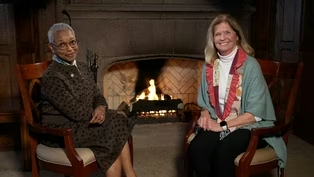
Preview: S4 Ep3 | 30s | Dr. Agenia Walker Clark talks about her role as president of Fisk University. (30s)
Providing Support for PBS.org
Learn Moreabout PBS online sponsorship











Support for PBS provided by:
Clean Slate with Becky Magura is a local public television program presented by WNPT