
Season 5: Episode 5
Season 5 Episode 5 | 26m 32sVideo has Closed Captions
We’re headed back to the late-’80s and ’90s on Retro Tennessee Crossroads.
This time the Crossroads Crew takes us to the tenth season in another favorite episode from the vault.
Problems playing video? | Closed Captioning Feedback
Problems playing video? | Closed Captioning Feedback
Retro Tennessee Crossroads is a local public television program presented by WNPT
Season 5: Episode 5
Season 5 Episode 5 | 26m 32sVideo has Closed Captions
This time the Crossroads Crew takes us to the tenth season in another favorite episode from the vault.
Problems playing video? | Closed Captioning Feedback
Where to Watch Retro Tennessee Crossroads
Retro Tennessee Crossroads is available to stream on pbs.org and the PBS app.
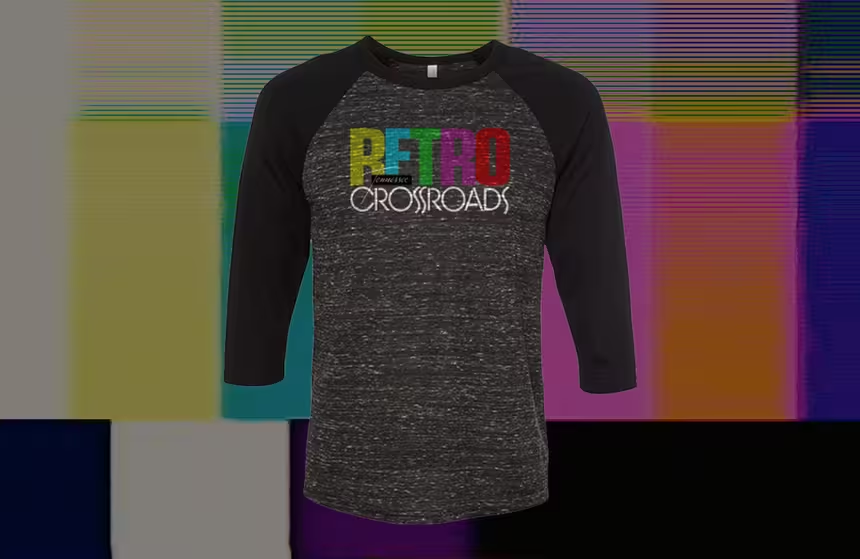
Rad Retro Tennessee Crossroads Tee
Show your love for your favorite Nashville Public Television show by donating and you'll get this limited edition Retro Tennessee Crossroads baseball shirt.Providing Support for PBS.org
Learn Moreabout PBS online sponsorship- Welcome to another episode of "Retro Tennessee Crossroads."
Howdy, I'm Ketch Secor, and we've got another great episode from our 10th season.
Here's Joe Elmore.
(upbeat music) - Hello, I'm Joe Elmore.
Good to see you again as we take off once more for "Tennessee Crossroads."
In our first story, we'll head up to Kentucky for a getaway at the home of Stephen Foster.
Jerry Thompson's going to meet a Manchester inventor who's got the town's hottest car on three wheels.
Susan Watson spends the day at a blueberry farm in Franklin, and Rob Wilds relives a patriotic celebration at the home place at Land Between the Lakes.
(upbeat music) Since summertime is prime time for getaways, we thought we'd get away with you to Kentucky's second oldest town.
Now, Bardstown has become increasingly popular for folks who want to spend a day or two or more in a town that refused to change much during the past two centuries.
(birds chirp) Kentucky has an abundance of naturally beautiful, genuinely historic destinations.
And if you want to capture the essence of the state, some folks will tell you to go to Central Kentucky first.
This is Bardstown, home of 7,000 or so folks who live in an ideal looking community where hospitality is a tradition.
Bardstown has been a town since the late 1700s, and quickly became a leading educational, religious, and commercial center of the West.
Bardstown is probably best known as the original home of my old Kentucky home, the old mansion that, according to legend, inspired Stephen Foster to write the state song.
Well, in recent years, Kentucky's second oldest town has become popular for other reasons too.
In fact, it's a favorite getaway attraction for folks who want to capture the heart of Central Kentucky.
- I'd like to welcome you all to the library.
Now, the portrait between the two windows there is of Stephen Collins Foster, the illustrious cousin of the Rowans.
- [Joe] Bardstown has 300 homes on the National Register of Historic Places.
Many, like my old Kentucky home, are open for daily tours.
By the way, Stephen Foster's cousin lived here and Foster would visit, often writing many of his famous songs within these walls.
Bardstown had been a town for 65 years by then.
In fact, it already had built the famed St.
Joseph Proto-Cathedral, the first Catholic cathedral west of the Allegheny Mountains.
Still a handsome, popular attraction for visitors of all faiths.
Now, if you're looking for 18th century style hospitality, the Old Talbot Tavern is an inn that's retained much of the furnishings and feeling it had when it opened as an outpost for westbound travelers.
The Old Tavern and Inn was open in 1779 during the Revolutionary War before becoming a stage stop.
The stages don't stop here anymore, but visitors do, and as always, they can spend the night, wet their whistle, or even have a good hot meal.
(soft music) The tavern has been in Jack Kelly's family for several generations, and no one's prouder of the old place than Jack, or the fact that it's played host to so many famous guests, including Daniel Boone, George Rogers Clark, General George Patton, and a youngster named Abe Lincoln.
- Abe himself was a small boy about eight or nine years old when they stayed here, and they were having a lawsuit in the courthouse here over the ownership of the Lincoln Farm.
Lincoln actually, the Lincoln family actually lost that lawsuit, lost their land, and that was the reason why they left to move to Indiana.
- It's been said that a few of the famous ghosts of the inn haven't checked out.
One of the most famous guests of the inn was outlaw Jesse James, who was a close friend of the sheriff of Bardstown and didn't have to worry about getting arrested.
Now, old Jesse behaved himself most of the time, except for one night, when according to legend, he and his buddies got drunk and decided to use this mural for target practice.
Bardstown is the bourbon capital of the world and once had dozens of distilleries.
Today it has four, which produce 85% of the world's bourbon.
While three of the distilleries offer guided tours, perhaps the best place to learn about whiskey making is here at Spalding Hall, a 160-year-old former college prep school and Civil War hospital.
It now houses the Oscar Getz Museum of Whiskey History, offering a look at the making of whiskey over the years and even its prohibition.
(soft music) Oscar Getz was founder of the Barton Distillery and started this collection in 1933, just after prohibition ended.
There's a room with a genuine once active moonshine still, a wall full of propaganda that helped usher in the 14-year ban on whiskey, and this room with a barroom mock up that shows the many ways liquor was advertised over the past century.
In all, there are more than 200 antique bottles, jugs, and decanters housed in the museum.
- All aboard!
- [Joe] Bardstown could easily be called a train lover's paradise, and the Kentucky Railway Museum is a main reason, along with its 1905 Rogers Steam Locomotive number 152.
It regularly transports passengers back in time.
There's a newer train, a 1940s vintage, where you dine and watch the passing scenery.
It's a dinner train that serves four course meals.
It even has a car complete with its own traveling kitchen.
There's no doubt about it, Bardstown is an old and attractive town with lots to see, but the main resource just may be the people.
They're friendly and seem to appreciate what they have here.
- Bardstown has a wonderful historical society that has been working for some time.
We've been real fortunate that all the citizens of Bardstown kind of work together to keep the history of Bardstown.
- [Joe] Dineen Bradley heads the tourism commission office, and she's quick to give the citizens credit for good PR.
- You'll see local citizens actually stopping and talking to tourists, inviting them into their homes, if they have a historic old home.
It's a quite unique place, where all the citizens are our best tour guides.
- If you ever come here, the hometown tour guides can offer you a lot of hospitality too.
And while you're here, you may not write a famous song like Stephen Foster, but you certainly may write home on some pretty postcards.
(soft music) Well, next, another encore feature from our old friend, Jerry Thompson.
This time, Jerry heads to Coffee County in search of a special kind of inventor.
Now, you all know that Saturn cars are built in Spring Hill, Nissans are made in Smyrna, but have you heard about the car made in Manchester?
Well, you will soon.
Here's Jerry.
- Well, in this day and time where most everything is either done by computer or committee, they say the day of the great inventor is dead.
There are no more Henry Fords or Thomas Edisons or Alexander Graham Bells.
Well, if you believe that, I've got a fellow I want you to meet.
He's August Dover of Manchester.
He's been driving his invention for more than 40 years.
It's a three-wheel car.
He originally built it for his kids, but it quickly became his personal toy.
- I started that.
I had a few airplane tail wheels in surplus back then.
It was '46 right after the war.
So I built this thing, and then as soon as I run it, why it went to turn over and I knew that wasn't for them, so I started practicing on it.
- [Jerry] And you just took it over.
- [Gus] Oh yeah, always been a show.
- [Jerry] And he still is.
A three-wheel car obviously doesn't offer enough excitement for Dover, so he just drives on two.
Has that ever actually flipped over with you?
- [Gus] Oh, yes.
That's the fun.
You see, it might look cute to you, but it's a vicious little vehicle.
Well, I built it that way.
It's always wanting to turn over, and you feel that when it's gonna turn over where it is, and you just keep going as close to it as you can and keep it from turning over.
And now that I'm 75, I don't like the pavement.
It looks smooth, but it, you understand, pavement rash is a pretty good deal.
- [Jerry] Behind every great inventor, there's a courageous and tolerant woman.
In this case, it's Dorothy Dover.
She risked her toes to demonstrate how tight the car will turn and almost gets whacked by the rear wheel.
But finally the reward, a ride with her husband.
Teenagers four wheelin' in a Jeep couldn't look more excited.
Ms.
Dover, what's it like living with a fellow like your husband all these years?
- Well, you never know what to expect next.
When our children were very small, well, my neighbors used to say they didn't ever know when they were gonna see our oldest son coming up the road with the motor on his back, because Gus put a motor on everything.
- [Jerry] Never a dull moment, huh?
- Never a dull moment.
He's always working on something.
If it's not one thing, it's two others.
- [Jerry] Whenever Dover drives his car, it attracts a crowd.
Leanna Fisher and her parents stopped to watch.
Then, she took a ride.
As long as she was on the high side, it was fine.
She obviously didn't like it from leaning toward her side.
- No!
- Before I decided to go for a ride in it, I wanted to know more about it, how it worked.
You got dual steering.
This turns the front wheel.
- Right, and that steers the back.
- And when you turn to the back, the whole motor and everything turns with it, right?
- Right.
- And you just got one seatbelt?
- One seatbelt for the passenger.
I don't use one, because I want to move around a little.
- Why does that make me feel uneasy when I'm thinking about riding with you?
- Well, I always try to go down this side so I land on the person riding - Oh, I see.
- and that keeps them in.
- And you want me, to make sure I'm still there, huh?
Well, I noticed you got a panic button here.
- [Gus] Yes.
- What does that do?
- Well, when people, they holler and I say, "Push the panic button," it doesn't do anything, but it always makes them feel better, so.
- I guess that's what a panic button should do.
Well, how about a little demonstration ride in this unique vehicle.
- No sooner said than done.
(engine revs) All right, here we go.
Oh man.
- Oh my goodness.
Keep it on the ground Gus, please.
Oh my God.
I got a wife and kids at home, Gus.
I just soon, you'd set me down.
- [Gus] All right, here we go.
- Oh my hell, hell yes.
I just as soon have all four wheels on the ground, folks.
What I mean four wheel, not but three.
How does the car manage to get a hefty fellow like me off the ground with such ease?
Well, after riding it, I still don't know.
I was too intent on holding on, to try to figure it out.
- How was that?
- That's plenty, Gus.
I think that's fine.
(Jerry honks horn) - This is not a Honda or a Ford or a Toyota.
Those guys made plenty of cars, hundreds of thousands.
August Dover in Manchester's only made one, this one.
But you know, I bet he's had more fun with this one than all those other guys put together.
This is truly one of a kind, and so is August Dover.
(upbeat music) - Thanks, Jerry.
You've all heard the expression "picking the blues," right, and what do you think of, Memphis, BB King?
Well, as Susan Watson recently discovered, picking the blues has a totally different meaning this time of year when you're down on the farm in Tennessee.
♪ Summertime ♪ ♪ And the living is easy ♪ ♪ Fish are jumping ♪ ♪ And the cotton is high ♪ - Yep, the living is easy here, and so is the picking.
Back when I was a kid growing up in Tennessee, we just had two kind of berries, strawberries and blackberries.
But there's another berry that's been taking the south by storm, and the bushes are so user-friendly.
There are no chiggers, no ticks, no snakes, no thorns.
Just big, ripe, juicy blueberries.
When Nancy Robinson first opened Cedar Brae Berry Farm 10 years ago, very few locals ventured out.
Most of her customers then were transplants from up north, where blueberries are more common.
- I did have to get the word around about blueberries to southerners a little bit, because there aren't that many.
But you know, they're realizing now, there are more blueberry farms and blueberries are becoming more common.
Fresh blueberries are becoming more common here.
So I probably have as many southerners as Yankees picking here now.
- [Susan] The neat rows of blueberry bushes beckon pickers of all ages, from tiny tots to senior citizens, all in search of those plump sweet spheres of blue.
- The ones you only have to pick are the ripe ones that are blue, not the pink ones.
- [Susan] Oh, and don't worry, there's plenty here for everyone.
- I've got about 1,500, about 1,500 plants.
And I'd say the average yield is about three gallons per plant.
It takes us all winter long to prune, and just really to shape them.
They have to be thinned out a little bit.
And if you don't prune, there's so many berries on it, they'd all be about the size of peas, you know, so that's one reason for pruning.
Basically, we also prune to make it comfortable picking height.
If you don't prune them, they'll, you know, they'll grow so high you can't reach the berries.
- [Susan] But Cedar Brae blueberry bushes are just right, and it's so much fun.
You'll pick a bucket full before you know it.
So what can you do with all those blueberries?
Well, just ask Myrna Lee.
She's already picked over 60 pounds this year.
- I picked like a blueberry square and I made poppy seed blueberry muffins and upside down cake made with whipping cream.
You can do anything you want with them.
Just substitute them for any berry you want.
- I'm not much of a cook at all.
So I've got to get the recipes from my customers.
So I said, "Okay, you all bring the recipes and I'll put the cookbook together."
- [Susan] And so the idea for the first annual Cedar Brae Blueberry Bake Off Contest was born.
- So we're just having a little contest of everyone's favorite blueberry dish, and whoever wins is gonna get their very own plant up here in the orchard that only they can pick from.
We'll prune it and fertilize it and maintain it, but only the Cedar Brae Blueberry Bake Off winner can pick from it.
- [Susan] But now, wait a minute.
Nancy's been around blueberries for a decade now.
She must have a favorite recipe.
- My favorite recipe, I would have to say, is this.
- Nancy tells me blueberry season just lasts two months, July and August, so if you're thinking about it, don't hesitate.
Trust me, they're going fast.
(upbeat music) - I hope we have some in the bucket when we get to the end of the road.
(thunder rumbles) - Well, you may as well have a seat now because you'll get wet going to the car.
- [Susan] Suddenly, an afternoon thunderstorm puts the picking on hold, but that's not so bad.
You can relax a while, enjoy the cool breeze, and listen to the rain on the tin roof.
Nancy and her husband, Peter, will weigh and bag your harvest while you daydream of the blueberry pancakes you'll be fixing Saturday morning.
And if blueberries aren't on your menu this week, Peter has some sage advice for you.
- They need to get out there and pick some and try them.
- [Susan] Why?
I think little Amanda put it best.
- Because they're blueberries and everybody loves blueberries sometimes.
(upbeat music) - And of course, traditionally, the picking season extends throughout the month of August.
Well, finally on the show, here's what Rob Wilds discovered on his trip to Land Between the Lakes on the 4th of July.
It was an authentic Independence Day celebration, the way folks would've celebrated it 150 years ago.
- Well, it being an election year, we thought it would be fun to go out to a political rally.
But you know, at Crossroads, we're nonpartisan.
That's right, both major political parties represented here, the Democrats and the Whigs.
Didn't I tell you, it's a political rally from July 4th, 1850.
(soft music) Part of the celebration would be music by that wonderful new composer, Stephen Collins Foster.
All part of July 4th, 1850 at the home place where 1850 lives year round.
But historic interpreter Maryanne Andres says the 4th of July is special.
- The Independence Day was the biggest holiday of the year for, especially as a community event.
You know, Christmas was celebrated as a very quiet home affair.
Thanksgiving was not a national holiday, and often was just a meal that was passed among friends.
But Independence Day, people actually left their farms and went to town and they would spend two to three days celebrating the nation's birthday.
You got to realize this is only about 70 years past the revolution, and so the fervor of the revolution has really not passed away from the second generation of families living here.
- [Rob] And so while music might provide the background, interpreter Ron Westfall says politics was always in the foreground.
- Well, I've had somebody once say that politics in the 19th century is what sex is to the 20th century.
You talked about it all the time.
- South Carolina has already made statements about seceding.
The split between North and South is already evident.
And so you have the Whig Party, which is really a party that is dying pretty much, and then you've got the Democratic Party.
Both of them are campaigning on issues that they think are going to be near and dear to the, you know, the hearts of Tennesseans and Kentuckians.
- [Rob] And so at a time when the fabric of the nation was coming unstitched, words were important, well-reasoned words, familiar then and now.
- When in the course of human events, it becomes necessary for one people to dissolve the political bans which have connected them to another, and to assume among the powers of the earth, the separate and equal station to which the laws of nature and of nature's God entitled them, a decent respect to the opinions of mankind requires that they should declare the causes which impel them to the separation.
We hold these truths to be self-evident that all men are created equal, that they are endowed by the creator with certain unalienable rights.
That among these are life, liberty, and the pursuit of happiness.
- [Rob] The Declaration of Independence is read and appreciated.
- We mutually pledge to each our lives, our fortunes, and our sacred honor.
Signed John Hancock and 55 others representing the 13 colonies.
(crowd applauds) - [Rob] And after the reading, toasts to the men who signed the Declaration.
- A more galiant band than ever fought at Thermopylae or bled on the plains of Salamis.
Truer hearts never beat for human liberty.
Clearer heads never pondered the rights of man.
- [Male Voice] Here, here.
- [Rob] And to the man who led the fight to guarantee the words in the Declaration, George Washington.
- His virtue will be an embalm in the affections of his countrymen, as long as wisdom and patriotism have a shrine in the temple of an American heart.
- [Male Voice] Here, here.
(crowd applauds) - [Rob] And of course, to the country itself.
- To union, temperance, and liberty, they are harmoniously blended with the highest destinies of our country.
- [Male Voice] Here, here.
(crowd applauds) (lady rings bell) (lady speaks indistinctly) - [Rob] Of course, after the remembering and the toasting comes the play.
- When I let go of the rope, you're going.
I'll give you a sign.
On your mark, get set, go.
- [Male Voice] Pull, pull, pull, pull, pull, pull, pull!
- [Rob] And there's eating too.
Watermelons kept cool the 1850s way in a spring house.
- Watermelon on the 4th of July.
- Yeah.
Okay, now we're eating it.
- Nothing better than that.
- [Rob] Well, how about fireworks?
They had rockets back in 1850, and they also had a special type of pyrotechnics involving gunpowder and a farm tool.
- [Man Setting Up Display] Anything we can do to make noise is certainly part of the activities then and now.
An anvil shoot was roughly the equivalent of the fireworks display of today.
Everybody goes out now to, in the late 20th century to see the fireworks, but in the 19th century, part of the local celebrations was firing an anvil.
(loud explosion) (crowd applauds) - [Rob] The whole thing at the home place is as American as apple pie, as American as freedom.
- [Celebration Organizer] So many of our national holidays today have come down to just being a day off from work.
So we all take off when we go to the beach or we go to the lake or we go someplace out of town, rather than staying home and really reflecting on the significance of the holiday.
And I think that's one of the things that, one of the things that our visitors like is that here you can get a little bit more sense of that, of the historic perspective of what the holiday was really all about.
(upbeat music) (upbeat music continues) (upbeat music continues) (soft music)









Support for PBS provided by:
Retro Tennessee Crossroads is a local public television program presented by WNPT