
What's next for Israel after election produces gridlock
Clip: 10/28/2026 | 4m 35sVideo has Closed Captions
What's next for Israel after election produces political gridlock
In Israel, nearly all the votes have been counted in Tuesday's election. Prime Minister Benjamin Netanyahu and his allies emerged as the largest bloc, but lost seats and fell short of the majority needed to form a government. The results leave Israel facing the prospect of political gridlock. Nick Schifrin reports from Tel Aviv.
Problems playing video? | Closed Captioning Feedback
Problems playing video? | Closed Captioning Feedback
Major corporate funding for the PBS News Hour is provided by BDO, BNSF, Consumer Cellular, American Cruise Lines, and Raymond James. Funding for the PBS NewsHour Weekend is provided by...
What's next for Israel after election produces gridlock
Clip: 10/28/2026 | 4m 35sVideo has Closed Captions
In Israel, nearly all the votes have been counted in Tuesday's election. Prime Minister Benjamin Netanyahu and his allies emerged as the largest bloc, but lost seats and fell short of the majority needed to form a government. The results leave Israel facing the prospect of political gridlock. Nick Schifrin reports from Tel Aviv.
Problems playing video? | Closed Captioning Feedback
Where to Watch PBS News Hour
PBS News Hour is available to stream on pbs.org and the PBS app.
Providing Support for PBS.org
Learn Moreabout PBS online sponsorshipGEOFF BENNETT: In Israel, nearly all the votes have been counted in yesterday's election.
Prime Minister Benjamin Netanyahu and his allies emerged as the largest bloc, but lost seats and fell short of the majority needed to form a new government.
The results leave Israel facing the prospect of political gridlock.
Nick Schifrin joins us now from Tel Aviv.
So, Nick, last night the opposition bloc was leading based on exit polls.
Now that the votes have been counted, where do the party stand?
NICK SCHIFRIN: Well, you're right, Geoff.
The polls essentially inverted the final results.
As you said, Netanyahu's Likud Party won the most seats of any party, and his coalition also won the most seats, even if, as you pointed out, they did lose their majority.
Now, as of now, with the vast majority of votes counted, they -- Netanyahu's bloc has 53 seats, well short of the 61 it needs for a majority in the Parliament or Knesset, but more than the 48 seats that the opposition Change bloc won.
One of the most significant outcomes of this election is the 19 seats that as of now the Arab parties won.
They are also anti-Netanyahu.
So you could conclude that the majority of the country rejected the current government, but that is not how Israeli politics work.
It is Netanyahu's coalition that has the most votes, which means, as of now, there's not only weeks ahead of us of negotiations, but there's no clear direction that the country has chosen to go, even though, Geoff, voters on all sides told us that the country is at a crossroads.
GEOFF BENNETT: And what are the scenarios, Nick, for what could happen next?
NICK SCHIFRIN: So, next week, Israel's president will invite one of the blocs to try and form a majority government.
When it comes to Netanyahu, he would have to persuade one of Eisenkot's coalition partners to defect.
But a Netanyahu official told me today they consider that impossible.
Or he could form what's known as a unity government with Eisenkot.
This has been done before, especially in times of war.
But Eisenkot and all of his allies have ruled it out.
They are vociferously anti-Netanyahu.
Now, Eisenkot does have his own path.
Note again, the Change bloc in blue and the Arab parties in green combined have more than 61 and could create a government together.
But Israelis have been resistant to Jewish parties needing Arab parties to be part of the ruling coalition, especially after October the 7th, and Eisenkot calls his coalition -- quote -- "Zionist."
But we will see what happens because there is a technical way for those Arab parties to support Eisenkot from the outside.
As for Netanyahu today, his campaign accused Arab voters of -- quote -- "stealing the election," an allegation police responded to by saying there is no investigative substantiation to the claims.
And last night, Netanyahu called for the Arab parties to be excluded.
BENJAMIN NETANYAHU, Israeli Prime Minister (through translator): We must form a right-wing national strong government.
That is what must be done.
We must not, must not endanger Israel and establish a government that is backed by anti-Zionist Arab parties.
NICK SCHIFRIN: Finally, Geoff, the fourth and perhaps most likely scenario at this point, one that many Israelis do not want, neither side gets to form a government or neither side succeeds in forming a government, and Israel heads to more elections.
GEOFF BENNETT: And what might all of this mean for Netanyahu and his political future, Nick?
NICK SCHIFRIN: Well, Netanyahu stays prime minister, even if he's supposed to act with restraint.
But analysts here say that he could choose to take the country to war.
A U.S.
official confirms to me that Netanyahu pushed for attacks on Iran before the Israeli election.
Israeli defense officials have also said that, and that led to this extraordinary warning last night from Gadi Eisenkot.
GADI EISENKOT, Israeli Prime Minister Candidate (through translator): I call on the heads of the security establishment and the civil service, remember that you serve only the state and the interests of the Israeli citizens.
Stand firm against any attempt to challenge you.
Netanyahu, do not dare use Israel's security for your own political needs.
NICK SCHIFRIN: Now, U.S.
officials have also said, including President Trump in public, that the U.S.
could go back to war with Iran after the U.S.
midterm elections.
And that would presumably give Netanyahu more leverage as these coalition talks play out, and which shows, really no matter what happens, Geoff, whether Netanyahu is able to form the coalition or not, we are still in a country dominated by Netanyahu and the opposition's inability to sell a majority of the country on the idea of a post-Netanyahu Israel.
GEOFF BENNETT: Nick Schifrin reporting again for us from Tel Aviv.
Nick, our thanks to you.
 New
America's long history of gerrymandering
Video has Closed Captions
America's long history of gerrymandering and its role in this year's midterms (9m 41s)
 New
Brazil's Flávio Bolsonaro flees to U.S. after election loss
Video has Closed Captions
Brazil's Flávio Bolsonaro flees to U.S. after election loss (5m 29s)
 New
Democratic and GOP strategists assess midterm landscape
Video has Closed Captions
Democratic and GOP strategists assess midterm landscape in final week (7m 47s)
 New
How the Associated Press tracks results on Election Night
Video has Closed Captions
How the Associated Press tracks and calls races on Election Night (3m 30s)
 New
News Wrap: Fed holds interest rates unchanged
Video has Closed Captions
News Wrap: Fed holds interest rates unchanged as inflation remains elevated (5m 1s)
 New
Polls suggest surprising Democratic gains in red-state races
Video has Closed Captions
New polls suggest surprising Democratic gains in red-state Senate races (3m 43s)
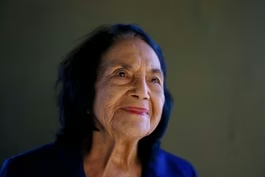 New
Remembering labor and civil rights leader Dolores Huerta
Video has Closed Captions
Remembering pioneering labor leader and civil rights icon Dolores Huerta (5m 45s)
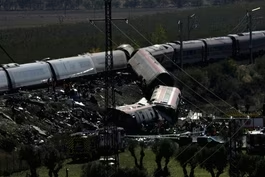 New
Shock, anger and mourning in Spain after train crash
Video has Closed Captions
Shock, anger and mourning in Spain after 2nd major train crash this year (2m 26s)
 New
Where key Senate races stand in final days of campaigning
Video has Closed Captions
Where key Senate races stand in the final days of campaigning (3m 18s)
Providing Support for PBS.org
Learn Moreabout PBS online sponsorship
- News and Public Affairs

FRONTLINE is investigative journalism that questions, explains and changes our world.
 New Episode
- News and Public Affairs

Today's top journalists discuss Washington's current political events and public affairs.



 New Episode

 New Episode
 New Episode

 New Episode



Support for PBS provided by:
Major corporate funding for the PBS News Hour is provided by BDO, BNSF, Consumer Cellular, American Cruise Lines, and Raymond James. Funding for the PBS NewsHour Weekend is provided by...