
How Ukraine is helping the U.S. defend against Iran's drones
Clip: 3/11/2026 | 5m 38sVideo has Closed Captions
How Ukraine is helping the U.S. defend against Iran's drone attacks
Now that the Shahed drone threat has arrived in the Middle East, the U.S. and Arab allies have formally requested Ukraine's help. This week, Ukrainian troops have arrived to begin their training. Nick Schifrin spoke with the official who's key to that effort.
Problems playing video? | Closed Captioning Feedback
Problems playing video? | Closed Captioning Feedback
Major corporate funding for the PBS News Hour is provided by BDO, BNSF, Consumer Cellular, American Cruise Lines, and Raymond James. Funding for the PBS NewsHour Weekend is provided by...
How Ukraine is helping the U.S. defend against Iran's drones
Clip: 3/11/2026 | 5m 38sVideo has Closed Captions
Now that the Shahed drone threat has arrived in the Middle East, the U.S. and Arab allies have formally requested Ukraine's help. This week, Ukrainian troops have arrived to begin their training. Nick Schifrin spoke with the official who's key to that effort.
Problems playing video? | Closed Captioning Feedback
How to Watch PBS News Hour
PBS News Hour is available to stream on pbs.org and the free PBS App, available on iPhone, Apple TV, Android TV, Android smartphones, Amazon Fire TV, Amazon Fire Tablet, Roku, Samsung Smart TV, and Vizio.
Providing Support for PBS.org
Learn Moreabout PBS online sponsorshipGEOFF BENNETT: Now that the Shahed drone threat has arrived in the Middle East, the U.S.
and Arab allies formally requested Ukraine's help.
And, this week, Ukrainian troops have arrived to start training.
Nick Schifrin speaks to a Ukrainian official key to that effort.
NICK SCHIFRIN: And I'm now joined by the adviser on strategic affairs to Ukraine's President Volodymyr Zelenskyy Oleksandr Kamyshin.
Oleksandr, thanks very much.
Welcome.
Good to see you again.
OLEKSANDR KAMYSHIN, Strategic Affairs Adviser Ukrainian President: Happy to see you again.
NICK SCHIFRIN: What is Ukraine now providing to the Middle East now that it is the Middle East that is facing the threat of Shahed drones, as Ukraine has faced for years?
OLEKSANDR KAMYSHIN: Well, this night, we had probably the biggest in our history, the record high night of the number of Shaheds and missiles coming in, and that was 700-plus.
So we're going through really complicated days, even though we got 11 official requests from Middle East countries.
NICK SCHIFRIN: Eleven requests across the region.
OLEKSANDR KAMYSHIN: European and U.S.
as well, to help with deterring Shaheds in the Middle East.
We get over 60,000 of Shaheds for the last year.
We learned now to take more than 90 percent of them down at cheap cost, in efficient way, and that's probably something we would be happy to share with our partners.
NICK SCHIFRIN: There's no one way to shoot these drones down, so the Ukrainians that are arriving in the Middle East, will they bring with them the ability to shoot down the drones, to bring down the drones electronically?
What are the capabilities that they're going to help teach these countries?
OLEKSANDR KAMYSHIN: That's all types of counterdrone solutions.
That's E.W.
NICK SCHIFRIN: Electronic warfare.
OLEKSANDR KAMYSHIN: Yes.
That's sonic acoustic sensors, and that's drone interceptors.
All types of them finally give us the capability to take down over 90 percent of Shaheds.
NICK SCHIFRIN: How difficult has it been for Ukraine to learn over the years how to create your own technology to do this on a cheap basis regularly?
OLEKSANDR KAMYSHIN: Well, Nick, last time we met, three years ago, we would not produce so much.
Now we have learned how to produce Zbroya.
That's Ukrainian name for weapon.
The drone interceptor cost is less than $5,000.
The cheapest ones are roughly $2,000.
Considering the cost of Shahed, because some of them cost from $50,000 to $150,000, that's pretty much efficient.
And, at this point, the fast relief is sending some assets and some trainers to them, and later we would be happy to go on with investments, joint procurement, joint production, whatever.
NICK SCHIFRIN: Is that Ukraine's long-term goal to get some of this international investment to build up its own capabilities?
OLEKSANDR KAMYSHIN: Exactly.
There is a drone deal in discussion between U.S.
administration and my President Zelenskyy, and we would be happy if the drone deals finally happens and we will have joint production of Ukrainian Zbroya in U.S.
NICK SCHIFRIN: As part of that drone deal, a senior Ukrainian official tells "PBS News Hour" that, last August, President Volodymyr Zelenskyy offered Ukrainian anti-drone technology to help defend the Middle East.
The official says the offer received no formal reply until Iranian drones started landing in the Gulf 11 days ago.
What has been the United States, what has been the Trump administration's role in trying to get some of this Ukrainian technology into the Middle East?
OLEKSANDR KAMYSHIN: At some point, there was a discussion that my president doesn't have cards.
DONALD TRUMP, President of the United States: You don't have the cards.
You're buried there.
Your people are dying.
OLEKSANDR KAMYSHIN: Looks like the card is already in his hands, and looks like the card is called Zbroya.
That's Ukrainian weapon.
We are happy to share the lessons learned.
NICK SCHIFRIN: Has Russia been improving Shahed drone technology that originally, of course, came from Iran, in order for these Shaheds to be better at evading air defense?
Have you seen that in Ukraine?
And do you know whether that technology has been transferred to Iran?
OLEKSANDR KAMYSHIN: Indeed, Nick, they made it better in Russia.
They innovate well.
We have to accept it.
And at this point, we know that they share back to Iran not only the technology, but also some components.
Some drones taken down in the Gulf have Russian components produced in Russia.
So, finally, it's both-way exchange of the technology between Iran and Russia.
NICK SCHIFRIN: And, finally, is Ukraine worried that, with the world's attention on Iran and the Middle East, the United States' attention on air defense for its own bases in the Middle East, that Ukraine will get fewer weapons?
OLEKSANDR KAMYSHIN: We are helping to make secure Gulf.
And we believe that we will still keep the same support from U.S., from Europe, from all our strategic partners, and we will get more with helping the Gulf.
The axis of evil is working well.
They support each other in a very strong way.
I strongly believe that all the allies, all the free world, as I say, will stand together.
And with things we learn how to produce in Ukraine, with resources you have, we will make the free world safer.
NICK SCHIFRIN: Adviser on Strategic Affairs to President Zelenskyy Oleksandr Kamyshin, thank you very much.
OLEKSANDR KAMYSHIN: Thank you, Nick.

Can tapping into oil reserves help stabilize prices?
Video has Closed Captions
Can tapping into oil reserves help stabilize prices? (6m 17s)

Group turns line dancing into therapy for grief and trauma
Video has Closed Captions
Miami group turns line dancing into therapy for grief and trauma (3m 25s)

How Trump's SAVE America Act would reshape voting
Video has Closed Captions
How Trump's SAVE America Act would reshape voting (6m)
Immigration crackdown sparks fear in people legally in U.S.
Video has Closed Captions
Minnesota immigration crackdown continues to spark fear among people in U.S. legally (7m 54s)

Iran targets ships in Strait of Hormuz, raising energy fears
Video has Closed Captions
Iran targets ships in Strait of Hormuz, raising global energy fears (5m 9s)
News Wrap: Tornadoes kill at least 2 in Indiana
Video has Closed Captions
News Wrap: Tornadoes kill at least 2 in Indiana (4m 51s)
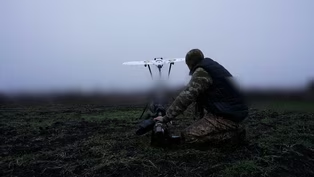
Ukrainian troops share lessons on stopping Iran's drones
Video has Closed Captions
Ukrainian troops share lessons learned from fighting Iran's Shahed drones (5m 5s)
Providing Support for PBS.org
Learn Moreabout PBS online sponsorship
- News and Public Affairs

FRONTLINE is investigative journalism that questions, explains and changes our world.

- News and Public Affairs

Amanpour and Company features conversations with leaders and decision makers.












Support for PBS provided by:
Major corporate funding for the PBS News Hour is provided by BDO, BNSF, Consumer Cellular, American Cruise Lines, and Raymond James. Funding for the PBS NewsHour Weekend is provided by...