
George Washington’s vision for American identity
Clip: 1/28/2026 | 11m 21sVideo has Closed Captions
George Washington’s vision for American identity tested 250 years later
As the country observes the 250th anniversary of the Declaration of Independence, Judy Woodruff is starting a new chapter of America at a Crossroads. She’ll explore what it means to be an American, how that idea has evolved since the nation’s founding and where we might be headed. She begins by looking at how closely our identity as Americans adheres to the template created by George Washington.
Problems playing video? | Closed Captioning Feedback
Problems playing video? | Closed Captioning Feedback
Major corporate funding for the PBS News Hour is provided by BDO, BNSF, Consumer Cellular, American Cruise Lines, and Raymond James. Funding for the PBS NewsHour Weekend is provided by...
George Washington’s vision for American identity
Clip: 1/28/2026 | 11m 21sVideo has Closed Captions
As the country observes the 250th anniversary of the Declaration of Independence, Judy Woodruff is starting a new chapter of America at a Crossroads. She’ll explore what it means to be an American, how that idea has evolved since the nation’s founding and where we might be headed. She begins by looking at how closely our identity as Americans adheres to the template created by George Washington.
Problems playing video? | Closed Captioning Feedback
How to Watch PBS News Hour
PBS News Hour is available to stream on pbs.org and the free PBS App, available on iPhone, Apple TV, Android TV, Android smartphones, Amazon Fire TV, Amazon Fire Tablet, Roku, Samsung Smart TV, and Vizio.
Providing Support for PBS.org
Learn Moreabout PBS online sponsorshipGEOFF BENNETT: As our country observes the 250th# anniversary of the Declaration of Independence## this year, Judy Woodruff is kicking off a new# chapter in her series America at a Crossroads.
AMNA NAWAZ: This year, she will explore# what it means to be an American,## how that idea has evolved since the nation's# founding, and where we might be headed.
She begins by looking at how closely# our identity as Americans hews to the## template created by war hero and# first President George Washington.
LINDSAY CHERVINSKY, Presidential Historian:# We refer to this as our smoking gun letter,## because you can start to see him# thinking about the fact that,## because he's an American, he's# actually a second-class citizen.
JUDY WOODRUFF: Inside a temperature-controlled# vault, historian Lindsay Chervinsky is showing me## a letter written by a then 25-year-old commander# of the Virginia regiment, George Washington.
He'd been fighting alongside the British# during the French and Indian War and was## angry at the lack of royal commissions# for him and his fellow Virginia officers.
LINDSAY CHERVINSKY: When you think about what it# means to be a full-fledged citizen, we think about## economic participation, political participation,# but also can you advance on your own merits?
And he has this realization early that# he's not going to in the British system.
JUDY WOODRUFF: Nearly two decades before the# American Revolution, Washington foreshadowed## the collision with Britain that would lead# to the creation of the United States and our## identity as Americans, a question that, 250# years later, many continue to wrestle with.
EMILY CHAFFIN, Mesa, Arizona: Being an American## means being able to pursue life# liberty and happiness unimpeded.
RICHARD WATKINS, Memphis, Tennessee:# Believing in those ideals that were set up## at the founding of our nation,# that's what being an American is.
JUDY WOODRUFF: We asked our viewers about being an## American and the responsibilities# that come with that identity.
JEN THISSEN, St.
Paul, Minnesota: In# order to be a citizen, that is an active## job description.
You need to learn.
You need# to understand.
And you need to participate.
KATHLEEN SINCLAIR CANNULI, San Jose, California:# To live by who got elected, all the various## viewpoints that people have, you don't have to# embrace them, but you have to live with them.
IAIN BURNETT, Raleigh, North Carolina:# We are a nation of immigrants.
And## except for those that are fully# Native American, at some point,## in the last 15 generations,# our ancestors immigrated here.
TONYA BAXTER, Grapevine, Texas: We're the# beacon on the hill.
Everybody wants to come## here.
Everybody has opportunity, no matter who# you are.
Come, do your best, and you can succeed.
LINDSAY CHERVINSKY: There was never one answer# to the question of, what is an American?
JUDY WOODRUFF: Chervinsky is the# executive director of the George## Washington Presidential Library and the# author of two books on the founding fathers,## including "The Cabinet: George Washington# and the Creation of an American Institution."
LINDSAY CHERVINSKY: They didn't necessarily# agree amongst themselves as to what was## the ideal American, what was the# right culture, the right religion,## the right economy, who belonged in that equation.
And from the founding, of course,# most people of color were excluded,## most women were excluded, Native Americans# were seen as sort of a separate entity.
And## then over the course of American history,# this has evolved and changed.
So it should## give comfort to people that we# have never had a clear answer.
JUDY WOODRUFF: After the# Revolutionary War was over,## Washington returned here to# his estate at Mount Vernon.
LINDSAY CHERVINSKY: He had# about 8,000 acres when he died.
JUDY WOODRUFF: The nascent nation was struggling# under the weak Articles of Confederation.
And in## 1787, Washington became a delegate to the# Constitutional Convention in Philadelphia.
The view that emerged was that this country,## rather than 13 squabbling colonies,# needed a strong central government.## Why did George Washington come to# believe that was the right answer?
LINDSAY CHERVINSKY: Well, they believed that# they needed a strong central government,## but they also believed that they needed# what they called an energetic executive.## Washington and many of the other military# officers understood how inept Congress was,## because it had failed to raise money for the army.
And so they really believed in a# stronger national government.
They## were sort of early nationalists# in a true sense of the word.
JUDY WOODRUFF: Washington supported ratification# of the new Constitution that created branches## of government, Congress in Article I and# an executive or president in Article II.
LINDSAY CHERVINSKY: Everyone knew that, if this# worked, he was going to be the first president.
JUDY WOODRUFF: No dissension?
LINDSAY CHERVINSKY: No dissension.
Ever.. And so when we look at Article II, it's very# short, especially compared to Article I. And## I think and I think a lot of historians# believe that a lot of the silence there is## because they just figured he would figure# it out once in office, and they trusted## him to establish precedents and norms that# would be good for the future of the nation.
JUDY WOODRUFF: As president, Washington was# committed to civilian control of the military,## the peaceful transition of power, and the# idea that everyone is held to the same laws.
But as a wealthy landowner in Virginia, Washington# also embodied the contradictions at the heart of## our founding documents, including the# idea that all men are created equal,## while codifying enslaved people as unequal,# including the more than 300 people enslaved## by George and Martha Washington at Mount Vernon# at the time of George Washington's death in 1799.
LINDSAY CHERVINSKY: They continued to sort of buy# and sell without thinking about the implications## for the people that they were buying and# selling until the revolution.
And then,## in the record, we can see a pretty distinct# shift in how Washington thinks about slavery.
First, he is interacting with free Black# communities in places like Philadelphia## and Baltimore and Boston.
He was also seeing# different types of agricultural production.## He also was interacting with ardent abolitionists,## including the Marquis De Lafayette, who was# very outspoken about his distaste for slavery.
But, lastly and I think most# importantly, by the end of the war,## some estimates suggest that about 30# percent of the Continental Army was Black.
JUDY WOODRUFF: In his will, Washington# stated that the people on his estate## that he controlled would be# free upon his wife's death.
LINDSAY CHERVINSKY: There's a lot that# he didn't do.
He didn't speak out against## slavery as president.
He did continue to# track down people who had run away.
And it## is in no way an excuse or a justification for# all of the people that he did hold in bondage.
But he knew his will was# going to be a public document,## and he knew it was going to be a major statement.
JUDY WOODRUFF: Chervinsky sees# Washington's evolution on slavery## as a reminder that the founding# fathers expected things to change.
LINDSAY CHERVINSKY: They didn't think what they# were creating was perfect.
They genuinely believed## that they were trying to create something# that was just a little bit better than## what they had had before.
They had all made# compromises to try and ensure ratification.
And they understood that there were problems they# were sweeping under the rug.
They could not figure## out how to solve the issue of slavery.# They also knew that there were problems## they couldn't possibly foresee because they# didn't have the ability to predict the future.
And I think what they hoped was, even if# the Constitution didn't survive forever,## that the republic would survive because# each generation was willing to embrace## that challenge to try and make the# nation just a little bit better.
VERONICA WILLIAMS, Paris, Tennessee:# We as Americans have found our way to## pull up our bootstraps in times of# dire need and in times of stress.
EMILY CHAFFIN: I believe the civil# rights movement was an overall success,## right.
Women's suffrage was# a success.
We can vote now.## We have basic rights.
I think that# we still have a lot of work to do.
AKSHAY SINGH, Tukwila, Washington: I# think the Congress should be expanded,## the House of Representatives should# be expanded to represent more people.
RICHARD WATKINS: We have really given up on filing# amendments to make our system more adaptable to## where the world is going, the way society is# going, particularly now in the 21st century.
ELENA SOTELO MCCRARY, San Ramon, California: I'm# still sad about the Equal Rights Amendment because## that's simple, two-paragraph language.
If that# had been adopted, it would have covered everybody.
JEN THISSEN: Thank you for your service, founding# fathers.
Great job, but now it's time to evolve.
JUDY WOODRUFF: Modern polling tells us we# are extremely divided along partisan lines,## and while feelings of pride in being# an American remain relatively high,## they have fallen significantly from# almost unanimous levels in the mid-'80s,## and those declines in the last decade have# mostly been among Democrats and independents.
LINDSAY CHERVINSKY: So this is Washington's# study.
This was his most private space when## he was here at Mount Vernon.
It was where he# did a lot of his thinking about the presidency,## where he reflected on things# like his farewell address.
JUDY WOODRUFF: In 1796, George Washington# published a farewell address that first## and foremost announced that he would# not seek a third term as president.
LINDSAY CHERVINSKY: He believed it was# essential that that first transition## happen while he was alive and happen in an# intentional way, so it would be less chaotic,## but also so that he was establishing a# precedent that presidents didn't serve for life.
JUDY WOODRUFF: The address also provided# warnings to his fellow Americans for## the future, cautioning against foreign# entanglements, regionalism, and partisanship.
LINDSAY CHERVINSKY: At this point, Washington# wasn't actually opposed to political organizing.## He was saying, don't allow political# parties to break the bonds of citizenship.
JUDY WOODRUFF: It seems so prescient today... LINDSAY CHERVINSKY: It's unbelievably prescient.
JUDY WOODRUFF: ... as we are so divided.
LINDSAY CHERVINSKY: Yes.
JUDY WOODRUFF: And, some.. LINDSAY CHERVINSKY: He did.
Our divisions and our partisan rancor have# been something.. again over the course of the last 250 years.
And# so he was certainly living it in the 1790s.
And## I don't know that he would have been terribly# surprised that it came up again and again, but## I do think that he would hope we could find a way# to put that American identity above the others.
It was a revolutionary thing to# do to form a nation based on an## idea.
Because it has survived and maybe we# have become a little bit jaded about it... JUDY WOODRUFF: Yes.
LINDSAY CHERVINS.. JUDY WOODRUFF: This visit to Mount Vernon,# reflecting on George Washington's influence on the## country to be, is just the start of our plan for# a yearlong inquiry as America observes its 250th.
We will be sitting down with more people# from across the country to ask how they## see their role as Americans, especially# at this deeply divided moment.
And we will## be looking for lessons from history to how# we begin to reach that more perfect union.
For the "PBS News Hour," I'm Judy# Woodruff in Mount Vernon, Virginia.
Detainees at Texas ICE facility protest living conditions
Video has Closed Captions
Clip: 1/28/2026 | 6m 46s | Detainees held at Texas ICE facility protest living conditions and treatment (6m 46s)
FBI raids Georgia elections office as Trump seeks voter data
Video has Closed Captions
Clip: 1/28/2026 | 11m 40s | FBI raids Georgia elections office as Trump administration seeks voter data from states (11m 40s)
Immigration fuels tensions as Congress faces shutdown threat
Video has Closed Captions
Clip: 1/28/2026 | 5m 17s | Immigration crackdown fuels tensions as Congress faces shutdown threat (5m 17s)

Miles O’Brien joins Geoff Bennett on ‘Settle In’
Video has Closed Captions
Clip: 1/28/2026 | 5m 24s | Miles O’Brien joins Geoff Bennett to discuss the Challenger disaster on ‘Settle In’ (5m 24s)
News Wrap: DHS says agents in Alex Pretti shooting on leave
Video has Closed Captions
Clip: 1/28/2026 | 6m 2s | News Wrap: DHS says agents in Alex Pretti shooting on leave (6m 2s)
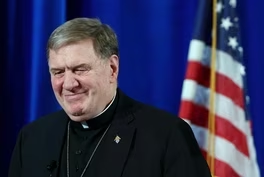
U.S. cardinal calls for the defunding of ICE
Video has Closed Captions
Clip: 1/28/2026 | 5m 52s | U.S. cardinal urges defunding of ICE: 'We need to see what's happening in front of us' (5m 52s)
Providing Support for PBS.org
Learn Moreabout PBS online sponsorship
- News and Public Affairs

FRONTLINE is investigative journalism that questions, explains and changes our world.

- News and Public Affairs

BREAKING the DEADLOCK sparks bold, civil debate on America’s toughest issues.











Support for PBS provided by:
Major corporate funding for the PBS News Hour is provided by BDO, BNSF, Consumer Cellular, American Cruise Lines, and Raymond James. Funding for the PBS NewsHour Weekend is provided by...