
August 6, 2021 - PBS NewsHour full episode
8/6/2021 | 56m 45sVideo has Closed Captions
August 6, 2021 - PBS NewsHour full episode
August 6, 2021 - PBS NewsHour full episode
Problems playing video? | Closed Captioning Feedback
Problems playing video? | Closed Captioning Feedback
Major corporate funding for the PBS News Hour is provided by BDO, BNSF, Consumer Cellular, American Cruise Lines, and Raymond James. Funding for the PBS NewsHour Weekend is provided by...
August 6, 2021 - PBS NewsHour full episode
8/6/2021 | 56m 45sVideo has Closed Captions
August 6, 2021 - PBS NewsHour full episode
Problems playing video? | Closed Captioning Feedback
How to Watch PBS News Hour
PBS News Hour is available to stream on pbs.org and the free PBS App, available on iPhone, Apple TV, Android TV, Android smartphones, Amazon Fire TV, Amazon Fire Tablet, Roku, Samsung Smart TV, and Vizio.
Providing Support for PBS.org
Learn Moreabout PBS online sponsorshipJUDY WOODRUFF: Good evening.
I'm Judy Woodruff.
On the "NewsHour" tonight: Help wanted.
The latest jobs report shows a strong labor market and a falling unemployment rate, but questions remain about COVID's effect on the recovery.
Then: the road ahead.
As the Senate moves forward with the infrastructure bill, we examine the potential investments in the country's aging transportation network.
Plus: a fight over rights.
Hungary's crackdown on its LGBTQ community prompts condemnation from other European leaders, and sets up a potential showdown at the E.U.
LUCY HOUGH: There has long been an ideological battle between the populist government here and the rest of the European Union.
But, so far, Hungary's actions in areas like LGBT rights have come with little consequence.
JUDY WOODRUFF: And it's Friday.
David Brooks and Jonathan Capehart examine what the results of two Ohio special congressional elections say about the two parties, the accusations against New York Governor Cuomo, and the ongoing politics of COVID-19.
All that and more on tonight's "PBS NewsHour."
(BREAK) JUDY WOODRUFF: The U.S. economy has turned in big new hiring numbers as it powers back from pandemic losses.
The Labor Department reports employers added a net 943,000 jobs in July, beating projections.
The unemployment rate fell half-a-point to 5.4 percent.
President Biden said today that continued growth depends heavily on more people getting vaccinated.
We will return to this after the news summary.
Battles escalated today across the country over masking up in schools to ward off COVID-19.
In Florida, Republicans running the state Board of Education approved tuition vouchers for private schools, where public schools impose mask mandates and parents object.
But New Jersey's Democratic governor ordered mask-wearing for everyone in school buildings, public and private.
GOV.
PHIL MURPHY (D-NJ): There are issues that are and must always remain above politics, and this is one of them.
Anyone telling you that we can safely reopen our schools without requiring everyone inside to wear a mask is quite simply lying to you, because we can't.
JUDY WOODRUFF: In other developments, a state judge in Arkansas temporarily blocked a ban on mask mandates, this one day after the governor, Asa Hutchinson, said he regrets the ban on mask mandates that he signed into law several months ago.
Amazon ordered all of its U.S. employees to wear masks at work.
And United Airlines became the first major U.S. carrier to mandate vaccinations for its workers.
The Biden administration today extended a pandemic pause on repayments, interest, and collections for federal student loans.
It will now run through January.
The U.S. Education Department said it is the last time the pause will be continued.
A catastrophic fire in Northern California is still spreading tonight.
It already engulfed one entire town as it burns into the record books.
Amna Nawaz has our report.
AMNA NAWAZ: After swelling 110 square miles in a single day, California's Dixie Fire is now the largest anywhere in the country, fueled by hot weather and gusty conditions.
As of this morning, the blaze also ranked as the third biggest in state history, stretching across 676 square miles in Northern California.
Greenville, a small, historic gold rush town, is already gone, consumed by flames Wednesday night.
Congressman Doug LaMalfa represents the district.
REP. DOUG LAMALFA (R-CA): We lost Greenville tonight.
And there's just not words for how us in government haven't been able to get the job done.
AMNA NAWAZ: Century-old wooden buildings overnight reduced to smoldering debris.
Sheriff Todd Johns is a lifelong resident.
TODD JOHNS, Plumas County, California, Sheriff: My heart is crushed by what has occurred there.
And to the folks that have lost residences and businesses, I have met some of them already.
Their life is now forever changed, and all I can tell you is, I'm sorry.
AMNA NAWAZ: Johns estimates more than 100 homes were destroyed, though there's no official accounting yet.
The fire's impact also reaches far beyond the state.
In Reno, Nevada, this morning, what appear to be snowflakes, actually ash, blowing in from more than 100 miles away.
The Dixie Fire is now into its fourth week.
The cause is under investigation.
But Pacific Gas & Electric says it suspects a fallen tree on one of its power lines.
The fire is so far just 35 percent contained.
Better weather conditions this weekend could help firefighters battling to save what they can, while others reflect on what was lost.
For the "PBS NewsHour," I'm Amna Nawaz.
JUDY WOODRUFF: More than 50 wildfires are also burning across Greece.
Thousands of people were forced to flee one fire north of Athens today.
At least one person was killed.
Firefighters and volunteers fought to contain the flames, despite high winds and searing heat.
Helicopters flew through smoke, dumping water to douse the fire.
Meanwhile, fires on the island of Evia forced evacuations by sea.
In Afghanistan, the Taliban have apparently captured their first provincial capital in a fast-moving offensive.
Insurgents today entered Zaranj, which is a city of 50,000 people in Nimruz province.
Fierce fighting also continued in the capital of Helmand Province, as a U.N. special envoy demanded that the Taliban end its assaults.
DEBORAH LYONS, United Nations Special Envoy For Afghanistan: We have seen a 50 percent - - 5-0 percent -- increase in civilian casualties, with the certainty of many more as the cities are attacked.
A party that was genuinely committed to a negotiated settlement would not risk so many civilian casualties.
JUDY WOODRUFF: The U.S. envoy spoke from Kabul, where the Taliban assassinated the Afghan government's media chief.
Back in this country, an aide to New York Governor Andrew Cuomo has filed a criminal complaint, alleging that he groped her.
It is believed to be the first such report to a law enforcement agency.
A state investigation found the aide is one of 11 women whom Cuomo sexually harassed.
He denies all the allegations.
A New Jersey gym owner is now the first person to plead guilty to assaulting a police officer during the January mob attack on the U.S. Capitol.
Scott Kevin Fairlamb's plea deal today could set a benchmark for other cases to follow.
He will be sentenced next month.
On Wall Street today, the Dow Jones industrial average gained 144 points to close at 35208, another record high.
The Nasdaq fell 59 points.
But the S&P 500 added seven, also reaching a new high.
And at the Summer Olympics, a U.S. track veteran made history in Tokyo; 35-year-old Allyson Felix took bronze in the 400-meter dash.
She now has 10 Olympic medals overall, the most ever for a female Olympian.
And in beach volleyball, Americans April Ross and Alix Klineman won gold, beating Australia today.
Still to come on the "NewsHour": where the money meets the road, how the infrastructure bill would update our transportation system; the sharp rise in COVID cases prompts questions about the need for vaccine mandates; Hungary's crackdown on its LGBT community prompts condemnation from European leaders; plus much more.
As we reported, today's jobs report indicates that the U.S. economy is continuing to make a strong comeback.
Wages are up, and the unemployment rate is down, now at its lowest level since the pandemic began in March of last year.
But concerns remain about the highly contagious Delta variant and how it could affect the economy's recovery.
Jared Bernstein is a member of President Biden's Council of Economic advisers, and he joins us now.
Jared Bernstein, welcome back to the "NewsHour."
So, some good news to report today.
Tell us, as you look at these numbers, what gives you confidence about this employment picture, and what do you see in there that concerns you?
JARED BERNSTEIN, White House Council of Economic Advisers: Well, I think the -- one of the main confidence-building factors here is not just what I saw in this report.
It's what I have seen in the last few reports; 943,000 jobs in July, of course, that's a big, important number, but, in fact, that's part of a trend.
We never try to overemphasize one month, because you get variation in these kinds of what we call high-frequency data.
If you look at over the past three months, we have been adding over 800,000 jobs per month.
Now, I know you have been tracking these job reports for a long time on the "NewsHour."
And you know that those are big numbers.
Since the president got here, we have added four million jobs.
That's historically unprecedented.
The unemployment rate fell by half-a-point, and, as you mentioned, the wage story.
So, what we know is that Americans are coming back into work, the labor supply is up over a million since January.
They're getting jobs.
They're seeing wage gains.
Shots and arms and checks in pockets are helping this economy get back to where the president wants to see it go.
JUDY WOODRUFF: And I also was asking you about what gives you concern.
As we know that, there were something like 6.8 million jobs that were lost at the start of the pandemic that still have not come back.
JARED BERNSTEIN: Yes.
JUDY WOODRUFF: A lot of these low-wage positions, positions in the service sector, restaurant jobs.
Do you worry that, because of the way life is changing in this country, that many of those jobs may never come back?
JARED BERNSTEIN: Well, I'm paid to worry.
And I earn my paycheck.
So, yes, I worry about that and many other things.
I would say one thing about the report that we're looking at month to month is precisely this hole that you mentioned, which greeted us when we got here.
That was about 10 million jobs missing relative to pre-pandemic levels.
Now, that's 6.7 million.
So, we still have considerable room to make up.
And that's one of the reasons, by the way, that the Rescue Plan continues to be important, providing aid to schools that need to reopen, providing housing assistance, particularly to people facing stressors in the rental markets.
JUDY WOODRUFF: Right.
JARED BERNSTEIN: And then moving on to the investment agenda through the Building Back Better and infrastructure programs.
JUDY WOODRUFF: Let me also, of course, ask you about COVID, the Delta variant.
These numbers were calculated, as we understand it, in the middle of the month of July.
Since then, we have seen this surge in COVID infection, the Delta variant.
How worried are you, Jared Bernstein, that that's going to create a real problem going forward?
JARED BERNSTEIN: It is, of course, a concern, and one we're tracking carefully.
But let me give you three contextual points that I think are really important to think about in this context.
First of all, we have already talked about one of them.
That's economic momentum.
When you have a labor market adding over 800,000 jobs per month, when you have cut the unemployment claims by half in almost six months, a trend that typically takes more than a year to occur, when your GDP is back above its trend at least a year before forecasters expected that, you have got real momentum.
Two, vaccinations.
When this president came into office, 1 percent, 1, percent, Judy, of adults were vaccinated.
Now that number is 60 percent.
Obviously, that's critically important to get that number up, but it's one of the reasons why we're not going back to lockdown, we're not going back to March 2020, or even January 2021.
And, three -- and maybe this is the most important in terms of forward-looking -- we have the public health scaffolding in place to meet this Delta challenge.
Now, people are going to have to chip in.
They're going to have to make sure that they get vaccinated.
We are going to have to work carefully with state and local policy-makers to make sure both relief dollars get out, particularly to people in the rental sector, but also to make sure that we keep getting those shots in arms.
But we have that public health policy infrastructure in place.
And that should give Americans a lot of confidence that these trends that we're seeing should persist.
JUDY WOODRUFF: Two other things to ask about, but, before I do, I just want to be sure.
If there are new restrictions that have to be imposed on people's lives because of this Delta variant or another variant afterwards, you're not concerned that that could put a crimp in the economy?
JARED BERNSTEIN: Well, I have tried to communicate that I'm concerned about all dimensions of things that could possibly push back against the recovery.
But, based on the momentum that we have had, 60 percent of adults vaccinated, and the scaffolding we have in place, I think we can meet these challenges, Judy.
JUDY WOODRUFF: Two other quick things, Jared Bernstein.
One is the administration announcement this afternoon that it's extending the moratorium on federal student loan repayments until January.
A lot of Democrats are saying, you ought to just let it go permanently.
Why not do that?
JARED BERNSTEIN: Well, that's a policy decision that's going to continue to be mulled over and one that we're going to look at carefully.
I mean, basically, you have got a lot of different people, a lot of different stakeholders in this.
There are lenders.
There are borrowers.
There are people who are facing these loans who have very high earnings prospects and don't necessarily need a loan cancellation.
And then you have people for whom carrying student loans -- and many of those are members of our minority communities -- are really a serious barrier to their getting ahead.
So, trust me, this is something that the president himself is looking at carefully and will continue to do.
JUDY WOODRUFF: Last thing, Jared Bernstein.
As you know, there are also the naysayers out there who are worried about inflation.
They're saying, with all this money sloshing around in the economy, pent-up savings that people are starting to spend, all the money the administration is putting out there, that what the real worry is right now is overheating this economy, and prices spiking up.
In just a few words, what do you think?
JARED BERNSTEIN: Well, if we look at the labor market today, we have started to see one of the key supply constraints begin to ease.
And that is the key answer to your question.
What we need to see is, where there are supply constraints in this economy, they have been related to the pandemic.
They have been related to taking a $21 trillion economy, shutting it off, and then turning it on again, strong demand meeting some of this constrained supply.
But we're seeing some of those constraints ease.
We're seeing that a little bit in lumber.
We're seeing that a little bit in the labor supply today.
We have seen a little bit of that in semiconductors.
I'd like to see a lot more there.
So that helps the auto sector.
But that's the way to think about this.
Pandemic-related sectors, that's where you have these transitory or temporary pressures.
And as those supply chains come back to life, those pressures will ease.
JUDY WOODRUFF: Jared Bernstein, who is part of the president's Council of Economic Advisers, thank you.
Congress' nonpartisan scorekeeper says the bipartisan infrastructure bill would add $256 billion to the federal deficit over the next decade.
As senators work to pass the plan in their chamber, our Lisa Desjardins takes another detailed look at the bill.
LISA DESJARDINS: At the heart of this billion-dollar-plus bill, by far, the biggest piece is classic transportation, things that help us move.
There is $453 billion total for roads, bridges and surface transportation.
Another $66 billion is for railways, and there are billions for ferries.
There is need.
An estimated one in five roads in this country is in poor condition, and tens of thousands of bridges need repair.
Anyone who has gone near an American city knows, for the most part, traffic is getting worse.
To help us unpack all of this, we have Tom Smith from the American Society of Civil Engineers joining us.
Tom, I got to say, this -- all of these numbers this week, sometimes, it feels like funny money.
Can you help us understand what nearly $500 billion means?
And how much of our road and bridge problem will that solve?
TOM SMITH, American Society of Civil Engineers: This is a problem that we have had, in failing to invest in our infrastructure for many, many decades.
We do a report card on America's infrastructure.
And for the last 20 years, we have been really failing to keep up.
And we have been kicking the can further and further down the road.
So the bill has continued to go up every year.
So, when we last released our report card in 2021, just this year, and as we do it every four years, we showed just on the surface transportation side, over the next 10 years, really an investment gap of $1.2 trillion.
That's out of a total of $2.6 trillion, when you look at all the 17 categories of infrastructure that ASCE evaluates with our report card on America's infrastructure.
LISA DESJARDINS: So, then, $500 billion gets us part of the way there, but not all the way?
TOM SMITH: Yes.
And the important thing to think about is that that is money that's being spent over a five-year period.
And when we look at our investment gap, and we say $1.2 trillion, that's over a 10-year period.
And we're also looking at all elements.
So, that requires federal investment, state, local and private investment.
So, while it's not going to get us all the way there by any stretch, it is absolutely a step in the right direction, and it's visionary.
It's a generational investment in our infrastructure.
And I think it's going to put us on the right track.
It will also, I think, spur additional investment at the state, local and private sector levels, and make our infrastructure more sustainable, more resilient, being able to look over the horizon, preparing for the future.
We're certainly seeing more severe weather events than we had when we were first building this infrastructure 50, 60, 75, sometimes 100 or more years ago.
LISA DESJARDINS: I want to talk about trains.
And I also want to talk about ferries.
We spoke to someone who works in the rail industry.
He told us what he thinks this bill means for them.
JIM MATHEWS, Rail Passengers Association: It's going to make it possible to build the track that we need, to expand.
It's going to make it possible to add service in a lot of cities all across the country, probably not the 160 that Amtrak would like to add, but it might come pretty close, depending on how we do it.
What it won't do, however, is buy us, for example, a network of high-speed trains all across the country.
LISA DESJARDINS: Now, for ferries, it's mostly all good news.
We spoke with a woman in Alaska who runs an ice cream shop.
And she depends on ferries.
It's easier to get to where she is usually by water than by land.
Here's what she said about the problem.
KARLA RAY, Store Owner: With constant breakdowns and ferries taken offline and ferries aged out, a community is really affected by its quality of life and what makes people want to stay in a community.
It's the lifeblood of a community if the residents are strong and healthy and happy.
And the ferry is our transportation.
LISA DESJARDINS: So, there's two other types of transportations that are getting huge influxes of cash over the next five years from this.
But this is a bill that has red ink to it.
Tom, I want to ask you about criticism from Republicans that this is not worth the debt.
And some of them say it could do some harm in inflation.
TOM SMITH: Well, I think this is absolutely a critical investment.
And, as you just heard, these are investments that we need in this country, whether it's rail or transit or even the ferry service.
This is a well-thought-out bill, as I have gone through it.
Obviously, it's not perfect.
It's -- but it's a bipartisan effort.
It's been really well-thought-out.
When you look at the ferry service that was referenced there, I know there was at least a billion dollars was referenced for ferry service in rural communities.
And while we talk about the cost of investing in our infrastructure, I think one of the things we will have to also consider is, what is the cost when we fail to invest, that time that we spend sitting in traffic, the inefficiencies in our system, repairing your car when you hit a pothole, added costs for goods and services, because we have failed to invest in our infrastructure?
This all costs us money.
And we did an economic study showing that we found it was $3, 300 per year per family.
That's the hidden tax that we're paying today.
So while we talk about, what does it cost to invest in our infrastructure and to modernize and maintain it, we have to ask ourselves, what's the cost if we fail to do that?
It's far greater.
LISA DESJARDINS: So, the bill is called the Infrastructure Investment and Jobs Act.
What do we know about how many jobs this really could create?
TOM SMITH: Well, I think this will create enormous opportunity and jobs in many, many different sectors, certainly in the construction industry.
There's a lot of jobs in the construction industry that will be created, but also those who finance, those who insure, those who design, those who operate and maintain our infrastructure.
Then you also have the suppliers.
So, this is going to have a major impact on manufacturing, which depends on the infrastructure that will now be better able to compete in a global marketplace.
And then, of course, all those workers are supported by a work force.
And they have pension plans and benefits.
And, by the way, they also have money now that they can spend to put back into the economy.
So, I think there are -- it's far-reaching, the job creation, by a bill like this, and also what it does for the economy.
LISA DESJARDINS: These are issues that affect every single American.
Tom Smith with the American Society of Civil Engineers, thank you for helping take us through it.
TOM SMITH: My pleasure.
Thank you.
JUDY WOODRUFF: As the country wrestles with this latest Delta-driven surge, governments and some corporations are mandating that their employees get vaccinated.
William Brangham looks at what these mandates require and whether they will make a difference.
WILLIAM BRANGHAM: That's right, Judy.
Many major cities and states, from New York City to California, have begun mandating vaccinations, or at least routine testing for government employees.
Yesterday, the Biden administration did the same for all federal workers, and the Pentagon is expected to follow suit.
Major U.S. companies, including Google, Tyson Foods, Walmart, United Airlines, and Disney, have also taken similar steps.
But many are still concerned that the pace of vaccination is still too slow, and want the private sector to do more.
Among them is Andy Slavitt.
He was a former senior adviser on COVID policy in the Biden White House.
Andy Slavitt, great to have you back on the "NewsHour."
You recently co-authored a letter with a bipartisan group of former government officials and public health experts urging the private sector to do more in this regard.
Let's say companies do take up your call.
How much will that, in fact, move the needle.
ANDY SLAVITT, Former Senior White House Adviser For COVID Response: We know that there's about 25 million Americans who say that, if they were asked by their employer, required by their employer, or needed to be vaccinated in order to get into major venues or gather in crowds, that they would, without objection, get vaccinated.
And what that tells us is that there's a number of people to whom getting vaccinated is neither a big positive or a big negative.
It's just not a big priority.
And so we need leadership from all across society, not just the government, but people who are trusted by individuals and who can lead individuals.
And corporations are the next big horizon.
So, if we do our jobs and if corporations step up, we can go from about 70 percent of adult Americans vaccinated to 80 percent.
And that would be -- make an enormous difference and save a lot of lives.
WILLIAM BRANGHAM: So, your sense is that this is moving that sort of mushy, movable middle of people who don't have a strong ideological objection to vaccines; they just need a little bit more of a nudge?
ANDY SLAVITT: Yes, I mean, we think it's important that we respect people's individual rights, that we -- that we listen to people who have concerns about getting vaccinated and try to answer their questions.
But, at the same time, we also have to have respect for people who don't have an option in the matter and people who can't get vaccinated because they are under 12 or who are immunocompromised, they have had cancer, they have had AIDS.
And so they don't get a say in the matter.
And so what we're asking employers to do is prioritize the needs and concerns of people who don't have a choice over all people that have a choice and are electing either not to get vaccinated or to get vaccinated by essentially saying, we require people who come to our workplace to be vaccinated, unless there's some very good reason.
And, if not, at the very least, everybody needs to be tested and show that they have got a negative test result continuously.
WILLIAM BRANGHAM: I was talking with the CEO of a hospital down in Louisiana this week who half their staff are not vaccinated.
And the CEO was somewhat leery of mandates, and they weren't doing one yet.
It seemed to me that his concern was a backlash, that mandating vaccination might cause more harm than good.
Do you share that fear that this could invite a backlash?
ANDY SLAVITT: I don't.
Look, I understand that there's people who feel strongly about this issue.
But I would call this the easiest hard decision you ever have to make, because the easiest hard decision you have to make is a decision where, at end of the day, you're saving people's lives, and you're also choosing people who can't really speak for themselves here.
So I would say to that CEO what I would say to any other CEO, that, yes, there's going to be people with strong opinions, and, yes, we know you would prefer to stay out of it, but, unfortunately, that's not the case we're living in.
And if you want to be part of bringing COVID to its knees, then you have got to step up and lead and do things like this.
And what we have experienced is that, for all of the people who might be concerned about it, there are many, many, many more people who say, thank you, I feel safer now.
WILLIAM BRANGHAM: I mean, but we have seen some significant pushback, from unions, from some law enforcement agencies.
Governors in Texas and Florida have passed laws blocking vaccine mandates.
You don't see this coming to more of a -- more conflict over this issue?
ANDY SLAVITT: Well, of course, there's -- of course, there's going to be conflict.
Of course, there's going to be strong opinions, and we need to listen to everybody.
The question is, who are we going to value here?
Listen to Asa Hutchinson, the Republican governor from Arkansas, who is now saying that it was a mistake to pass the kind of laws that were passed, and also in Texas in Florida.
The difference between Asa Hutchinson and the governors of, say, Florida, Ron DeSantis, is, he has no political aspirations.
He's only -- other than to be governor of the state, and to keep people in the state healthy.
And I think it's a matter of what we prioritize and what we value.
And if what we value is a commitment to one another, and keeping each other safe, and putting this pandemic behind us by reducing spread and getting schools open, there's no question that employers will take more aggressive actions.
And, again, I think there's room in certain situations for people who have reasons not to get vaccinated to say, fine, but we need you to show up at work and take a negative test on a regular basis, because we have to be able to assure the people who come on our premises that we're going to keep them safe.
WILLIAM BRANGHAM: All right, Andy Slavitt, former White House COVID adviser, thank you very much for being here.
ANDY SLAVITT: Thank you.
JUDY WOODRUFF: The rights of LGBTQ people in Hungary are increasingly under threat, according to activists in the Eastern European country.
Last month, a law came into force that restricts depictions of homosexuality and sex reassignment to children in schools.
The law has drawn intense opposition from other countries in the European Union and has become a battleground for what the bloc stands for.
Special correspondent Lucy Hough has this report from Budapest.
PROTESTERS: We're here, we're queer!
LUCY HOUGH: It may look like a celebration, but this is a march of defiance.
The LGBT community here in Hungary has long felt under attack.
But the government's enactment of a new sex education law has galvanized activists.
Organizers say the crowd at this year's Budapest Pride March was the biggest in its history.
KRISTOF, Pride March Attendee (through translator): There is a growing anti-LGBT message from Hungary's government and the media associated with it.
I'm terrified that this could turn into a situation where wider society starts to turn against the community.
SZILVI, Pride March Attendee (through translator): Human rights are universal, and the right to love who you want needs to be protected.
This law discriminates against gay people and seems to compare homosexuality with child abuse.
LUCY HOUGH: Legislation passed in June places strict limits on teaching about homosexuality and transgender issues in schools.
It's included in a bill targeting pedophilia.
For activists, it is yet another encroachment of fundamental rights.
The government says it's all part of a broader agenda designed to protect families and children, rejecting criticism at home and abroad.
Zoltan Kovacs is the government's state secretary.
ZOLTAN KOVACS, Hungarian State Secretary For International Communications: The hostility of the attitude coming from abroad and the reactions, let's call it the political attacks, the politically motivated attacks, are a little bit amazing, especially in the face of the very consistent, step-by-step policy-making of the Hungarian government for the past decade.
So, nobody could understand this new law, new legislation as a surprise, in face of the efforts we have done for the past 10 years to reinforce families.
LUCY HOUGH: The education of children has become a key battleground in Hungary's deepening culture war.
Much can be traced back to the publication of a children's book last year called "Wonderland Is For Everyone."
The text reimagines fairy tales with characters from minority backgrounds.
Some parents welcomed its inclusive message, but, elsewhere, there was an outcry.
One far-right politician shredded the book on camera.
A government minister described it as homosexual propaganda.
It can now only be sold with a disclaimer warning of a divergence from traditional gender roles.
Its co-author, Boldizsar Nagy, was unprepared for the response.
BOLDIZSAR NAGY, Co-Author, "Wonderland Is For Everyone": The last months, I had -- I received a lot of online threats and messages from strangers which are trying to demonize me.
And they tell me that I am -- I should die because I am gay and things like that.
These are just hateful.
They are just pure hate.
LUCY HOUGH: Members of Hungary's LGBT community say they feel increasingly unsafe.
Many, like Nagy, plan to leave the country.
But, elsewhere, the popularity of the government's conservative agenda endures.
An election year is on the horizon, and strong anti-LGBT rhetoric appears part of a new political strategy from Prime Minister Viktor Orban.
His Fidesz party has been showing signs of marching into semi-authoritarianism since it took power in 2010.
There are signs this strategy is firming up support from the party's conservative base and from those further to the right.
Edda Budahazy is a member of a far-right organization.
EDDA BUDAHAZY, Leader, Magyart Mozgalom (through translator): We were very happy to see the child protection law pass.
We have been watching Western countries for a long time, and can see the dangers of all this so-called gender ideology.
It's a risk to our society.
LUCY HOUGH: The European Union is watching developments from its Brussels headquarters with alarm.
European capitals say the legislation is a violation of the bloc's values and discriminates against LGBT people.
There has long been an ideological battle between the populist government here and the rest of the European Union.
But, so far, Hungary's actions on areas like LGBT rights have come with little consequence.
As international condemnation mounts, the E.U.
is under pressure to act.
The E.U.
has now announced legal action against Hungary and its closest ally, Poland, where strict anti-gay measures have also been introduced.
The bloc has threatened to withhold billions of dollars in post-pandemic recovery funding.
Ursula von der Leyen is president of the European Commission.
URSULA VON DER LEYEN, President, European Commission: Europe will never allow parts of our society to be stigmatized, be it because of whom they love, because of their age, their ethnicity, their political opinions, or their religious beliefs, because we should never forget, when we stand up for parts of our society, we stand up for the freedom of the whole of our society.
LUCY HOUGH: But a row over so-called child protection is just the latest battleground between Budapest and Brussels, who have previously come to blows on issues like migration, corruption and the rule of law.
There has long been discomfort about how big a role the E.U.
should play in the domestic affairs of its member states, particularly those deemed to have an illiberal agenda.
Such tough talk from the E.U.
is only hardening the Hungarian government's line.
ZOLTAN KOVACS: If there is a political clash, we stand for it, we go for it, because we believe that we are right.
Child protection does not belong to any European competence.
Definitely, it belongs only to the Hungarians.
LUCY HOUGH: Three days before thousands marched through Hungary's capital, Budapest, for pride, Prime Minister Viktor Orban announced a referendum on the new LGBT legislation.
Orban hopes the public will vote in his party's favor and silence his critics overseas.
But activists are alarmed by a referendum designed to strip fundamental rights of a minority group.
There are fears that life for LGBT people in Hungary will only get harder.
BOLDIZSAR NAGY: It will be just worse and worse, because they're -- the government uses this homophobia as a political tool in their hate campaign.
And I think, until the election, they won't have any other topics.
LUCY HOUGH: In the face of rising numbers of homophobic attacks, Hungary's LGBT community is determined to remain visible.
But activists fear the damage to an inclusive society here will be felt for many years to come.
For the "PBS NewsHour," I'm Lucy Hough in Budapest.
JUDY WOODRUFF: This week, the Delta variant presented new challenges for the Biden administration, New York's attorney general found its governor sexually harassed multiple women, and voters went to the polls in two Ohio congressional districts.
And here to sort it all out, we have the analysis of Brooks and Capehart.
That is New York Times columnist David Brooks and Jonathan Capehart, columnist for The Washington Post.
It is so good to see both of you here.
JONATHAN CAPEHART: Good to see you, Judy.
JUDY WOODRUFF: Thank you.
Thank you for joining us on this Friday night.
Jonathan, I'm going to start with you.
Good news today for the Biden administration, good jobs numbers, but we know at the same time every day they are juggling how to handle this COVID pandemic, the Delta variant, deciding how hard to come down on vaccinations, whether to ban, or not, masking.
What are the political risks here for the president?
How do you -- what are the political calculus -- calculi for him?
JONATHAN CAPEHART: Well, I think part of it is, whose side are you on?
Are you on the side of the folks who are leery about the vaccines still, the folks who are holding out, the people who don't want to get the vaccine, or are you on the side, those of us who are fully vaccinated and want to get on with the art of living, going back out to restaurants and things, unencumbered?
And I think the president this week dropped on the side of the vaccinated, demanding that people -- pleading and demanding that people get vaccinated, and then taking it not, by name, but by inference, to the Republican governor of Florida and what he's doing, in terms of making it difficult for school districts to mandate masks for their children or the localities.
So I think the president is making the calculus.
If I can peer into what's happening in the White House, it's that the more people get vaccinated, the sooner we can get back to living a normal life, which has implications for the economy and everything else.
JUDY WOODRUFF: So, even if there's short-term blowback, David, that it's worth it?
DAVID BROOKS: Well, I don't think mandating vaccination is -- would be worth it.
I mean, I support vaccination all day long.
But we -- this is America, and America is a country with strong distrust for central authority.
I think, if we mandated it from Washington, it would generate enormous blowback among those who are not vaccinated and not help the cause.
I think getting private insurers and schools and others to insist on vaccination is much safer.
It's decentralized.
People are presumably going to workplaces and colleges and schools that they like, and so they have a little more trust.
And so I think that's a smarter way to do it, without generating so much blowback.
I really liked what Andy Slavitt said earlier in the program, to emphasize those 25 million who have no principled objection, and make it easier for them.
If that could take us up to 80 percent vaccination, that would be a really significant achievement, without creating even more of a cultural war around this thing.
JUDY WOODRUFF: And -- but continuing to watch, because we don't know what this Delta variant is going to do, of course.
Do want to ask you about the congressional races this week in Ohio, two different congressional districts, two different primaries.
In the one district in Cleveland, Jonathan, you had -- Marcia Fudge's district -- you had mainstream Democrat win pretty persuasively against a more, shall we say, left-wing progressive Democrat.
And this is at a time when a lot of people are asking, how much influence do the more -- most progressive members of the Democratic Party have right now?
So how do you read what happened?
JONATHAN CAPEHART: Well, the way I read what happened is that the more progressive wing of the Democratic Party doesn't hold any sway when it comes to these special elections.
I'm reminded of speaker Tip O'Neill saying all politics is local.
We have a tendency to nationalize every congressional race, every local race, and forget about the fact that the people who are actually running, they're not running national races.
They're running local races.
And when you look at the race between Shontel Brown and Nina Turner, you have to remember that President Biden won that district with 79.8 percent of the vote.
And so you have one candidate who's the local chair of the Democratic Party and another candidate who has said some unspeakable things about what it would mean to her if she voted for Joe Biden.
And so you just put that out there, and Nina Turner thinking she would actually win that race, I think, was laughable.
DAVID BROOKS: Yes, though she was leading early, apparently.
Yes, I'm about to nationalize it.
(LAUGHTER) DAVID BROOKS: So, you go back to 2019, AOC is riding high, the Green New Deal.
The party looks like it's shifting quite rapidly to the left, and they think they have got a lot of running room there.
I recall, in one of the presidential debates, basically, people were asked, would you open the borders, decriminalize, and most of the candidates raising their hand said, yes, I would do it.
And I was like, where is this party going?
But then look at what happens.
Joe Biden wins the election against 17 people, all of whom were to his left.
And a lot of people think that defund the police, some excesses on the left cost them down-ballot races.
And then we have had a bunch of races in the last several months where the -- I don't want to say moderates, I want to say party regulars beat progressives.
And so the -- you have got the New York mayoral race, the Virginia gubernatorial race, three House races in which Ohio is one.
And, partly, it's moderate left.
But, really, it's, how do we do change?
Do we do change within the party, within the system, or do we try to disrupt the system?
And I think it's pretty clear the base of the Democratic Party says, we believe in our party, we want to do change within the system, which is sort of the Biden hymnal.
JUDY WOODRUFF: Which is -- as David said, this is where the last few -- the New York mayor's race, other pieces of evidence that the party is not as far left as some had argued that it was.
JONATHAN CAPEHART: Right.
And, also, keep in mind that the base of the Democratic Party, primarily, it's the African-American voter.
And African-American voters, I think a lot of people tend to think that, oh, they're Black, therefore, they're progressive, and not realizing that, no, we Black voters, we're actually more pragmatic.
What are you going to do?
How are you going to make my life better?
How are you going to make my community safer?
And when it's looked through that lens, Shontel Brown's win shouldn't be as surprising as it was for a lot of people.
JUDY WOODRUFF: And just quickly, the other Ohio primary race, the Trump-endorsed candidate, Michael Carey... DAVID BROOKS: Right.
JUDY WOODRUFF: ... David, emerged.
I guess not a huge surprise.
Donald Trump has influence.
(LAUGHTER) DAVID BROOKS: Yes, especially when it's a 12-person race, and they're all sort of unknown.
So, the Trump guy is going to have a huge advantage.
I think it's still very hard to win a Republican primary if Donald Trump is not on your side.
It's impossible if you're against Donald Trump.
But I'd add one thing, which is that 17 Republican senators endorsed the infrastructure bill that Donald Trump opposed.
So I think, on Donald Trump, you can't cross Trump.
On culture war issues, you can't cross Trump.
But, on policy, you can cross Trump.
And the party is more flexible or confused about what it believes on policy matters than it was five years ago.
JONATHAN CAPEHART: And to -- just a slight spin on that, and that is the Trump candidate won in this race.
The Trump candidate didn't win, I believe it was in a special election in Texas.
But in that Texas race, the thing I say to keep an eye on is, Trump didn't win, but Trumpism won in that race.
And so, instead of looking at who Donald Trump has endorsed, look at how closely the candidates are to what Donald Trump actually says he believes in.
JUDY WOODRUFF: How closely they're aligned.
The last thing I want to raise with both of you is this really massive development out of New York state, David, and that is this damning report by the New York state attorney general about Governor Cuomo, that he -- just lots of detail about how he treated harassed 11 separate women who worked for him and a hostile climate, to put it mildly, in his office.
DAVID BROOKS: Yes, well, a powerful pathetic man is a dangerous thing.
And he's both those things.
And you read the report, the grabbing, the toxic environment, the screaming, making women do pushups, saying, get me a girlfriend, I need a girlfriend who can handle pain, like, it's all beyond belief.
And will he step down?
Well, obviously, he should.
It's morally disgraceful.
He needs to -- he needs to work on a lot of stuff, and sort of get his soul in order.
But he apparently has no other life.
And so he's just hanging in there.
I think it's even more pathetic the way he's hanging in there, because he's basically putting his job over any hope for his own character.
And that's just -- well, those are not good values.
JUDY WOODRUFF: People are asking, is this somebody who's going to resign, or is he going to go through impeachment, which the New York Assembly appears ready to do, to start proceedings?
JONATHAN CAPEHART: And, as we sit here right now, it looks like he's going to go through with it.
I would add a third characteristic.
He's a man with no friends.
Andrew Cuomo hasn't had friends in Albany in a very long time, before this happened.
And yet, still, a majority of the Assembly would vote to impeach him.
He has no friends.
The head of the Democratic Party says, you must resign, who was one of his closest political allies.
And if he does get impeached, the other thing to keep in mind is that the lieutenant governor, once those proceedings start, Andrew Cuomo is technically no longer governor.
Lieutenant Governor Hochul is the one who is the acting governor of the state.
JUDY WOODRUFF: Right.
JONATHAN CAPEHART: That would be unbelievably pathetic.
JUDY WOODRUFF: How does something like this, David, go on for as long as it's apparently gone on?
I mean, people are now saying -- we interviewed a woman the other day who worked for him 20 years ago, was his press secretary when he was the secretary of housing and urban development, who said he was the same person then.
How does something like this go on?
DAVID BROOKS: One, power of intimidation, which is really strong.
Two, a climate where there aren't that many women at the top.
So it's a male culture, and people are willing to look the other way.
Third, Albany is a little isolated.
And the governor has a lot of power to intimidate a lot of people throughout the community.
And so -- but the lesson of -- and then just what we have learned, since MeToo is that it -- well, it went on for 4,000 years.
And so the fact that it's still dragging on in various places shouldn't surprise us.
It was the norm in a lot of offices around America and around the world for centuries and centuries.
JUDY WOODRUFF: What's your sense of how somebody can get away with something like this for so long?
JONATHAN CAPEHART: People turned a blind eye.
People pretended it didn't happen.
People felt powerless.
Another thing is, in Albany, in New York, the Cuomo name is a big name.
It is a powerful name.
It's an historic name.
I remember watching his father, Governor Mario Cuomo, give the speech at the Democratic Convention.
What year was that, 1984?
DAVID BROOKS: Yes, somewhere around there.
(CROSSTALK) JONATHAN CAPEHART: 1984.
I remember being the nerdy kid sitting, watching this speech, and listening to him and realizing, those are values -- those are values I believe in.
I'm a center-left person because of Mario Cuomo.
To see what his son has done to that family named is just sad.
JUDY WOODRUFF: I actually covered that convention.
It was a mesmerizing speech.
But I just -- just to wrap this up, David, I think a lot of people are watching men and women and saying, how much of this goes on in American political life?
DAVID BROOKS: Yes, people go into politics out of vanity, out of power.
Some of them are remarkable people, and they want to serve the country.
There are a lot of emotionally damaged people in politics, who have -- as Jon said, they know how to suck up, and they know how to kick down.
They don't have horizontal friendships.
And it's not the norm, but it's many people we know in this profession.
And so they're lonely and they get more pathetic, they get more needy, and they eventually treat everyone around them, men, but especially women, as objects, who do not have feelings on the other side of the relationship.
And that's just a sort -- a single sort of person, not all people, but some of the people that politics attracts.
JUDY WOODRUFF: Well, it's -- we don't know how it's going to end.
We think we know.
But we will wait and see, but what a sad and terrible picture that emerged this week.
David Brooks, Jonathan Capehart, thank you both.
JONATHAN CAPEHART: Thank you.
DAVID BROOKS: Thank you.
JUDY WOODRUFF: Born and raised in Jamaica, June Grant knew that architecture was her calling from the age of 5.
Today, she is the founder and design principal at blink!LAB, an environmentally conscious and social justice-oriented design studio in Oakland, California.
Tonight, she gives her Brief But Spectacular take on being an architect, part of our arts and culture series, Canvas.
JUNE GRANT, Founder, blink!LAB: I am one of 467 licensed African American female architects in the country.
And I believe there are 150,000 licensed architects in the U.S., so we are the ultimate minority of minorities.
There's a lot of talk about representation matters, but I think it really matters if we're in the community on a regular basis, because kids and parents need to see us in action to understand that it is possible.
I grew up on the island of Jamaica in the city of Kingston, and, like many families, I was encouraged to take practical courses, accounting, science.
But I was never interested.
And when I finally migrated to the U.S., I knew I always wanted to do architecture.
My focus is actually high-performance buildings, where we're looking at the building as a holistic experience, in terms of energy use, water use.
Growing up on Jamaica, I have lived through power outages, I have lived through water shutoffs.
I have showered from a bucket.
Those life experiences were important to me, and they have actually fueled how I approach a building and how I approach design.
Scarcity around resources is something I grew up around.
And so I'm conscious of waste.
I am really good as a design strategist.
So, what I do is, I ask a lot of questions.
I'm actually better at asking questions and sitting down and sketching.
So, I will ask, where have you been?
What decisions were made in the past that brought us to this point?
What are your aspirations for the future?
And then I tend to project even further forward, 20, 50, 100 years.
And those are the clients that are attracted to me, because they're actually looking for very long-term solutions.
And then I reverse-engineer to see, how can we create those solutions today?
I grew up in a conservative society, where girls were supposed to play with dolls, and my boy cousins were given the chemistry set.
But I wanted the chemistry set.
I think we have to start allowing girls to explore, explore the hammer, explore with the nails, use a saw, make things, explore, be physical, tumble, fall, scratches.
We need that, because it is that exploration and self-confidence that you will need going forward in any field you pursue.
My name is June Grant, and this is my Brief But Spectacular take on being an architect.
JUDY WOODRUFF: Such a great perspective.
And you can watch all our Brief But Spectacular episodes at PBS.org/NewsHour/Brief.
And on the "NewsHour" online: More extreme heat is putting U.S. farmworkers at risk of heat-related illnesses and even death.
But there are few protections available to them.
We explore the issues that exist for these workers and what federal standards could help on our Web site.
That is PBS.org/NewsHour.
And stay with PBS, how the Delta threat is seen at the White House.
Join Yamiche Alcindor and her panel tonight on "Washington Week."
And that is the "NewsHour" for tonight.
I'm Judy Woodruff.
Join us online and again here on Monday evening.
For all of us at the "PBS NewsHour," thank you, please stay safe, and have a good weekend.
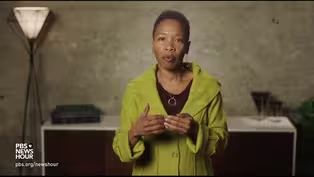
A Brief But Spectacular take on being an architect
Video has Closed Captions
Clip: 8/6/2021 | 3m 13s | A Brief But Spectacular take on being an architect (3m 13s)

Brooks and Capehart on the politics of COVID, Ohio elections
Video has Closed Captions
Clip: 8/6/2021 | 12m 52s | Brooks and Capehart on the politics of COVID-19, Ohio elections, accusations against Cuomo (12m 52s)

California's Dixie Fire burns its way into the record books
Video has Closed Captions
Clip: 8/6/2021 | 1m 57s | California's Dixie Fire burns its way into the record books (1m 57s)
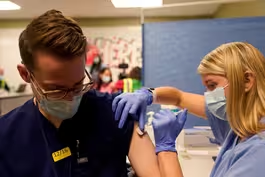
Delta-driven surge spurs employers to mandate vaccinations
Video has Closed Captions
Clip: 8/6/2021 | 6m 12s | Delta-driven surge spurs governments, major companies to mandate vaccinations (6m 12s)

How the infrastructure deal aims to bolster streets, bridges
Video has Closed Captions
Clip: 8/6/2021 | 6m 37s | How the infrastructure deal aims to bolster our aging transportation network (6m 37s)

Hungary's crackdown on LGBTQ community prompts condemnation
Video has Closed Captions
Clip: 8/6/2021 | 7m 26s | Hungary's crackdown on its LGBTQ community prompts condemnation from European leaders (7m 26s)
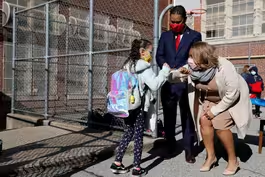
News Wrap: Battles escalate over masking up in schools WRAP
Video has Closed Captions
Clip: 8/6/2021 | 7m 8s | News Wrap: Battles brew over masking up in schools to ward off COVID-19 (7m 8s)

U.S. economy powers back from pandemic losses
Video has Closed Captions
Clip: 8/6/2021 | 7m 54s | U.S. economy powers back from pandemic losses, but concerns remain over the delta variant (7m 54s)
Providing Support for PBS.org
Learn Moreabout PBS online sponsorship
- News and Public Affairs

FRONTLINE is investigative journalism that questions, explains and changes our world.

- News and Public Affairs

Amanpour and Company features conversations with leaders and decision makers.











Support for PBS provided by:
Major corporate funding for the PBS News Hour is provided by BDO, BNSF, Consumer Cellular, American Cruise Lines, and Raymond James. Funding for the PBS NewsHour Weekend is provided by...