
Jungles | Parenthood
Season 44 Episode 9 | 52m 22sVideo has Audio Description
See how jungle animal parents raise children by mastering their environment.
See how jungle animal parents raise children by mastering their environment. An orangutan spends eight years teaching her baby the ways of jungle living, and a crab becomes the ultimate chemist to create the perfect home for her crablets.
See all videos with Audio DescriptionADProblems playing video? | Closed Captioning Feedback
Problems playing video? | Closed Captioning Feedback
Major support for NATURE is provided by The Arnhold Family in memory of Henry and Clarisse Arnhold, Sue and Edgar Wachenheim III, The Fairweather Foundation, Charles Rosenblum, Kathy Chiao and...
Jungles | Parenthood
Season 44 Episode 9 | 52m 22sVideo has Audio Description
See how jungle animal parents raise children by mastering their environment. An orangutan spends eight years teaching her baby the ways of jungle living, and a crab becomes the ultimate chemist to create the perfect home for her crablets.
See all videos with Audio DescriptionADProblems playing video? | Closed Captioning Feedback
How to Watch Nature
Nature is available to stream on pbs.org and the free PBS App, available on iPhone, Apple TV, Android TV, Android smartphones, Amazon Fire TV, Amazon Fire Tablet, Roku, Samsung Smart TV, and Vizio.
Buy Now
Explore More Ways to Watch
Bring the beauty and wonders of wildlife and natural history into your home with classic NATURE episodes.Providing Support for PBS.org
Learn Moreabout PBS online sponsorshipMore from This Collection
This five-part natural history series explores the extraordinary strategies and adaptability that animal parents employ to give their young a head start in life. Narrated by David Attenborough.
The Greatest Adventure | Parenthood
Video has Audio Description
Parenthood is the ultimate journey, full of danger. (54m 33s)
Video has Audio Description
Ocean parents must master dedication and intelligence to raise their young. (51m 50s)
Video has Audio Description
Animal parents must overcome freshwater’s constant changes. (52m 14s)
Video has Audio Description
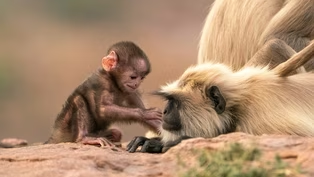
Animal parents must balance risk and reward to raise their young in grasslands. (51m 54s)
Providing Support for PBS.org
Learn Moreabout PBS online sponsorship♪♪ ♪♪ ♪♪ ♪♪ ATTENBOROUGH: Incredible ingenuity, dedication, and extraordinary teamwork.
This is what it takes to be a parent on our planet.
Meet the hardworking parents raising their families... doing all they can to protect... ...and provide for the next generation.
Discover the extraordinary ways animal parents navigate their world.
But a changing planet is forcing them to adapt.
Success for all parents has perhaps the greatest of consequences.
It ensures the future of life on Earth.
This is "Parenthood."
♪♪ [ Birds chirping, animals chittering ] ♪♪ ATTENBOROUGH: A mother orangutan in Borneo is building her bed for the night.
♪♪ First, a mattress of fresh leaves.
Her young son, a few branches below, is getting to work on his own bunk.
Not entirely successfully.
♪♪ It will take her almost a decade to prepare him for independence.
♪♪ Like many youngsters, he decides that his mother's bed is preferable.
And climbs up for a cuddle.
♪♪ It takes years to perfect jungle living, and all rain forest parents learn to rely on the trees to protect and provide for them.
♪♪ ♪♪ Bhutan.
A Himalayan kingdom where the forests are regarded as sacred.
♪♪ The jungles here provide a refuge for many rare species.
♪♪ Among them are some of our planet's most dedicated parents.
♪♪ Rufous-necked hornbills.
Male and female pair for life, and each year they renew their bond.
Raising a hornbill chick takes teamwork.
The first step is to secure a good home.
♪♪ Unlike most birds, hornbills don't make nests but prefer a hole in a tree.
♪♪ ♪♪ Fortunately, the ancient forests of Bhutan contain plenty of options.
Once the pair have found one that seems suitable, the female starts collecting mud from the forest floor.
♪♪ With it, she builds a barrier across the entrance that will prevent any strangers from getting in.
♪♪ But she is now imprisoned.
And she will remain so for the next hundred days.
♪♪ ♪♪ She will be totally reliant on her partner for food.
You'd better be up to it.
Fruit forms the bulk of his offerings.
♪♪ A caterpillar is a welcome treat once carefully prepared.
♪♪ Most of the time the food is gratefully received.
♪♪ But not always.
♪♪ [ Buzzing ] The lack of choice is beginning to get to her.
♪♪ The male works hard to maintain his daily deliveries.
His commitment is total.
♪♪ ♪♪ But then... one beak becomes two.
♪♪ Their growing chick is thriving.
But the nursery is becoming increasingly cramped and a touch grubby.
Dad does his best to keep them both properly fed.
[ Insects buzzing ] But conditions inside the nest are now almost unbearable.
Finally, after three months of imprisonment, she decides the time has come to leave.
And to introduce her chick to the outside world.
♪♪ The male now starts to withhold food, a clear sign that he, too, thinks that the time has come.
She starts to chip away at the baked mud.
♪♪ Her flight muscles are stiff and weak.
♪♪ Inch by inch, she squeezes her way out.
♪♪ Freedom again.
♪♪ Her chick, however, needs more time.
The world seems rather daunting.
His father swoops in to offer some encouragement.
It's time to go.
♪♪ All his parents can do now is watch.
The chick's journey inevitably has to begin with a leap of faith.
♪♪ ♪♪ ♪♪ He is ungainly and awkward.
But that could have been a lot worse.
They'll remain by his side for the next six months.
♪♪ Jungles may appear to be full of opportunities.
But competition for homes can be intense.
This Sri Lankan pug-nosed frog has been lucky.
He's bagged a prime location.
It even has a pool in the basement.
♪♪ And it's not long before an interested female arrives.
♪♪ Their embrace can last for days.
♪♪ But as soon as the eggs are laid, the female leaves.
He is now on his own, a single parent.
♪♪ His new brood quickly attracts unwanted attention.
Frog's eggs are food for many jungle creatures.
He can protect them from some of the smaller threats.
But he has little defense against the bigger ones.
The tiger tarantula with a leg span the size of a human face.
They can paralyze its victims with a single venomous bite.
♪♪ Almost nothing is safe from it.
♪♪ Certainly not a defenseless frog father.
♪♪ ♪♪ The little frog bravely holds his ground.
♪♪ ♪♪ ♪♪ Actually, these two have met before.
They both live in the same tree hole.
The tarantula has a nice dry penthouse at the top... ...while the frog prefers the damp basement.
♪♪ The stay-at-home frog keeps the place clean and free of ants.
And the spider acts as a full-time security guard.
♪♪ Together, they make an excellent team.
One that ensures a future for two entirely different families.
♪♪ ♪♪ For some parents, finding a suitable home is just the start of a very long journey.
Learning the intricacies of the jungle can take a lifetime.
And in the forests of Borneo, the amount of food on offer varies hugely each year.
Orangutans have an encyclopedic knowledge of the forests.
They not only know which plants are safe to eat, but when and where to look for them.
This knowledge is passed down to their young, and today's lesson begins with a pandanus plant.
A meal of its leaves is an excellent way to start the day.
♪♪ ♪♪ Bibi is an experienced mother and has been giving her son, Bayas, daily lessons for the last seven years.
♪♪ Orangutan are mostly solitary animals.
If Bayas is eventually to survive on his own, Bibi has a lot of work to do.
♪♪ She will need to show him everything the forest has to offer.
Including where to find over 300 different kinds of food.
♪♪ Like all orangs, Bibi is vulnerable on the ground, but down here, there is important food.
♪♪ Termites.
They're packed with nutrients, an important supplement for their regular diet.
Bayas isn't yet brave enough to sample them, but at least he's paying attention.
♪♪ A varied diet can be the difference between life and death.
And at his age, Bayas should really be fending for himself.
But he still relies on his mother to show him the best bits.
♪♪ There is no shortage of leaves.
♪♪ But even so, he wants those particular ones that his mother is eating.
♪♪ And she is beginning to find that very irritating.
♪♪ Eventually, he gets the message and finds a branch of his own.
♪♪ ♪♪ Large fig trees are few and far between.
And you have to know when they will be full of fruit if you are not to make unnecessary journeys.
They've timed their visit perfectly.
Hundreds of figs are beginning to ripen.
♪♪ Bibi has devoted nearly a decade of her life to each of her children.
Bayas is approaching the end of his training and will soon need to branch out on his own.
♪♪ ♪♪ Leaving his devoted mother will be one of the most difficult moments in his life.
♪♪ And he isn't quite ready for it yet.
♪♪ ♪♪ Iguazú National Park in Argentina.
♪♪ A mother coati is in her nest with a litter of kits.
♪♪ She has looked after them with great care since the day they were born.
But now they are close to independence, and she's able to start foraging further.
♪♪ Coati live in tight social groups, and the adults take turns to care for each other's young.
♪♪ And keep them out of harm's way.
♪♪ As one mother disappears into the canopy... ...the other is left in charge, and she is going to have her work cut out.
The kits are just about manageable when in the trees.
But once on the ground, it becomes total chaos.
♪♪ ♪♪ The babysitter is doing her best... ♪♪ ...but every time one of the missing kits is found... ...another wanders off.
♪♪ It's a babysitter's nightmare.
♪♪ ♪♪ Meanwhile, the other female is enjoying some quiet time on the other side of the river.
She calls to the group.
[ Coati calling ] But the babysitter knows that the kits would find it difficult to make the crossing.
They'd become separated.
♪♪ The babysitter, however, has an idea.
She has learned to use something that previous generations didn't have.
A bridge.
[ People chattering ] ♪♪ ♪♪ She just has to get the youngsters across it unscathed.
♪♪ ♪♪ ♪♪ The babysitter rounds up the final straggler and carries him to safety.
♪♪ ♪♪ With the group reunited, everyone has had quite enough adventure for one day.
By sharing parental responsibilities, these coatis now successfully raise more offspring than they could ever do on their own.
Jungle parents have to be endlessly resourceful.
And the forests of Jamaica are now home to a creature whose ancestors were once ocean goers... ...but who now live in the tiny pools of water that form at the base of jungle plants.
♪♪ This is a mother bromeliad crab.
But her new home isn't perfect.
It requires constant maintenance.
Dead leaves fall into it, and that just won't do.
The leaves have got to be removed.
♪♪ For her growing brood, nothing is too much trouble.
♪♪ Cleaning the nursery is just the start.
♪♪ For the first ten days, the tiny crabs don't have hard shells and are easily picked off by hungry predators.
♪♪ ♪♪ They're totally defenseless.
Fortunately, their industrious mother knows just the thing.
The forest is littered with snail shells rich in calcium.
♪♪ She drops a few into the nursery pool, where they will dissolve and can then be reabsorbed by the tiny crablets, helping them to toughen up.
♪♪ Managing her nursery pool is a daily battle.
Too many leaves, more shells to find.
And each day she risks losing more of her brood.
♪♪ ♪♪ When eventually the youngsters' shells have hardened, she has to provide them with food.
♪♪ She doesn't leave the safety of her bromeliad home, but relies on food coming to her.
A millipede in search of a meal of decomposing leaves.
She readies herself.
It won't be easy, but there's a bounty to be had.
♪♪ ♪♪ She eventually gets to grips with her capture... ...and breaks it up into bite-sized chunks.
♪♪ The body of the millipede will not only feed her whole family, but will also help to further strengthen the crablets' shells.
♪♪ The crablets love the guts best.
♪♪ The mother crab has managed to create an environment that suits her family.
But some jungles are now being transformed in ways that make raising young almost impossible.
The karst forests of southern China.
The limestone peaks are home to one of the rarest of monkeys.
The white-headed langur.
♪♪ This infant is one of the last of his kind.
He's precious not just to his mother, but for the future of his entire species.
A ledge high up these vertical cliffs may be a safe place to sleep.
But it's less than perfect as a nursery.
♪♪ Traveling around up here is not for the inexperienced.
But eventually all langurs must learn to master the rock face.
♪♪ ♪♪ Fortunately, there are plenty of others willing to lend a hand.
♪♪ Young langurs can spend as much as a third of their time under the care of other females.
♪♪ Around mid-morning, the group begin their daily descent to the base of their pinnacle.
One false step here could be fatal.
♪♪ ♪♪ But this is the place where their mothers find their food.
♪♪ ♪♪ Whilst their babies are free to develop their climbing skills.
♪♪ Langurs need a variety of fresh leaves every day.
Not long ago, the troop had a much larger forest territory.
But they have become isolated on their rocky island.
Which is now entirely surrounded by farmland.
♪♪ The patches of jungle that remain have become increasingly rare.
♪♪ A couple of outsiders have been spotted approaching through the fields.
♪♪ [ Horn honks ] Looking to take over the island.
♪♪ Rival males will kill the offspring of others.
♪♪ So the mothers quickly get out of the way... ...and retreat to the safety of the cliffs.
♪♪ Leaving the rest of the troop to resist the attack.
♪♪ ♪♪ The intruders have been repelled for now.
But not everyone has gone unscathed.
♪♪ The troop begin the long climb back up.
The mother and her precious cargo carefully work their way up the cliff.
♪♪ The walls are near vertical and the holds razor thin.
♪♪ ♪♪ These langurs have adapted to this perilous habitat.
And their island refuge provides the mother and her baby with a safe haven for now.
But one day, the youngster will be forced to leave his mother's family... ...and establish a territory of his own.
And that will not be easy.
♪♪ Forest habitat is being lost all over the world, but nowhere is this more pronounced than in the Brazilian Amazon.
Every year, vast swathes of jungle are deliberately set on fire... ...leaving millions of animal parents homeless.
Many are forced to find refuge in nearby patches of forest.
♪♪ Among them a particularly rare and seldom seen creature.
An Amazonian tapir, a close relative of rhinos and South America's largest land mammal.
Her young calf sticks close by her side.
They are in search of a new territory which has the resources they need to survive.
♪♪ ♪♪ ♪♪ Finding enough vegetation to eat is not a problem.
But many jungle plants lack crucial minerals, and some contain a mix of toxic chemicals.
♪♪ Over time, these toxins can build up in a tapir's body.
Eventually, some need to seek out a remedy.
She leads her young calf upstream in the hope of finding the cure.
The female knew where to go in the patch of forest where she was born.
But as her former territory continues to burn behind her, she is forced to look for somewhere new.
♪♪ ♪♪ As night falls, the jungle comes alive.
♪♪ ♪♪ Using her keen sense of smell, she cautiously guides her calf through the forest.
♪♪ The more animals they encounter, the closer they're likely to be to their destination.
♪♪ She can smell something familiar in the darkness.
♪♪ ♪♪ Clay.
The remedy that she and her calf so badly need.
♪♪ It's thought the clay neutralizes the toxins and provides essential minerals lacking in their diet.
Others arrive, all searching for the same thing.
The particular chemical compounds within this clay.
♪♪ As more tapir arrive, they dig into the soil, making it accessible to other, less powerful species.
♪♪ ♪♪ The location of this clay lick is a crucial part of the calf's education.
There are unique sites like this all over the Amazon, including many that have not yet been identified by humans.
Even the most remote forests on Earth are no longer immune from modern disturbances.
The Daintree in northern Australia.
Dinosaurs once lived here.
♪♪ And their feathered descendants still prowl the understory today.
A cassowary.
This one is nicknamed Crinkle.
♪♪ He's nearly 45 years old, and like all cassowary fathers, he has the responsibility of rearing the young.
Success is never guaranteed, and this year is tougher than ever.
It's the middle of the dry season.
Crinkle's head casque helps him shed heat quickly.
But his chicks have no such defense.
In these temperatures, they need to drink almost every day if they're to survive.
But it has hardly rained for months.
The forest is parched and many of the riverbeds are dry.
♪♪ ♪♪ Crinkle breaks up some fruit for his chicks, but it won't sustain them for long.
♪♪ ♪♪ ♪♪ He must find water.
There is a remote pool at the far limit of his territory.
The journey there is risky, but his chicks are hungry and thirsty and increasingly desperate.
Even in a good year, only 50% of cassowary chicks survive.
He urges them on.
♪♪ They must be cautious.
The search for water is drawing other animals into the area.
♪♪ Feral pigs introduced by humans are now abundant in these forests.
Following their scent, wild dingoes are also moving in.
Both of these animals are known to kill cassowary chicks.
♪♪ Crinkle is by no means defenseless.
His razor-sharp talons are effective weapons, but he will be unable to save his chicks if they don't find water soon.
♪♪ ♪♪ At last.
♪♪ And for now, they are alone.
♪♪ ♪♪ The oasis provides precious relief.
♪♪ And what is more, the quandong tree here is full of fruit, a food much relished by cassowaries.
♪♪ And in return, the cassowary distribute the seeds around the forest, helping the trees to spread.
♪♪ ♪♪ All over the world, animals and trees depend on each other.
But there are some trees that do more than we ever thought possible.
♪♪ A 200-year-old Ajo tree in Costa Rica covered in golden blooms.
♪♪ As one of the largest trees in the area, it has unrestricted access to the sun.
♪♪ However, for the saplings growing on the forest floor, collecting the relatively little light that filters down isn't quite so easy.
But the Ajo tree's influence is great.
Its immense canopy absorbs the sunlight, using its energy to synthesize sugars in its leaves... ...which then circulate through its branches right down to its roots.
♪♪ Here it collaborates with microscopic fungi, and it distributes excess nutrients to the tiny saplings nearby.
This underground network enables trees to support the next generation.
♪♪ These complex relationships take years to establish.
And it's clear that, as trees age, they become increasingly important for the forest, acting as protectors and providers for the whole ecosystem.
A cavity in the Ajo's ancient trunk provides a home for a family of bats.
♪♪ ♪♪ And thousands of insects visit it each day.
♪♪ This Ajo is a keystone of the forest.
♪♪ But it's not unique.
♪♪ The world over, such giant individuals play a pivotal role in their respective forests.
♪♪ They are the key to a healthy jungle.
From the majestic meranti in Borneo to the giant kapok in Brazil, trees like these provide homes for a huge variety of animal families.
♪♪ Entire neighborhoods depend on them for food.
♪♪ They are the center of their community... ♪♪ ...and are vital to all parents who make their homes in jungles.
♪♪ ♪♪ ♪♪ ♪♪ ♪♪ To learn more about what you've seen on this "Nature" program, visit pbs.org.
♪♪
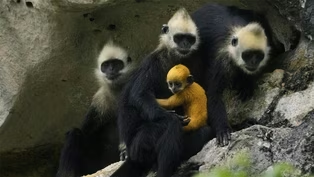
A Mother’s Escape: A Langur’s Dangerous Climb
Video has Closed Captions
Clip: S44 Ep9 | 2m 36s | A langur mother climbs dangerous cliffs to protect her baby from rival males. (2m 36s)
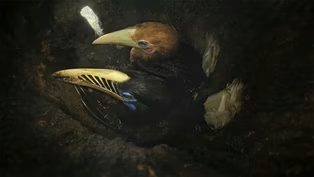
Pregnancy Jail? The Nesting Strategy of Hornbills
Video has Closed Captions
Clip: S44 Ep9 | 3m 12s | This isn’t a prison. It’s a carefully built nursery, sealed for protection. (3m 12s)
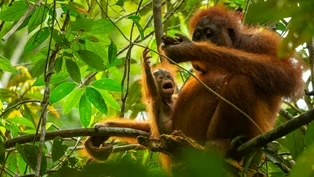
Preview of Parenthood "Jungles"
Video has Closed Captions
Preview: S44 Ep9 | 30s | See how jungle animal parents raise children by mastering their environment. (30s)
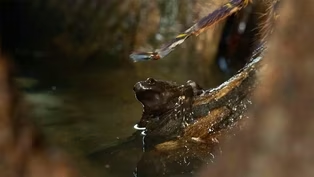
Unlikely Roommates: Frog Dad & Tiger Tarantula
Video has Closed Captions
Clip: S44 Ep9 | 2m 54s | Sharing a tree hole, two unlikely allies protect their families in very different ways. (2m 54s)
Providing Support for PBS.org
Learn Moreabout PBS online sponsorship
- Science and Nature

Explore scientific discoveries on television's most acclaimed science documentary series.














Support for PBS provided by:
Major support for NATURE is provided by The Arnhold Family in memory of Henry and Clarisse Arnhold, Sue and Edgar Wachenheim III, The Fairweather Foundation, Charles Rosenblum, Kathy Chiao and...