
In the Shadow of the Bitterroots, Part Two
Season 40 Episode 5 | 26m 46sVideo has Closed Captions
Biking, rafting, skiing and climbing: adventure abounds in Idaho's rugged Bitterroots.
From biking through century-old railroad tunnels on the Route of the Hiawatha to rafting the wild Selway River, motorcycling the remote Magruder Corridor, and climbing to Trapper Peak's 10,000-foot summit, we explore the many ways adventurers find their way into the Bitterroot Mountains.
Problems playing video? | Closed Captioning Feedback
Problems playing video? | Closed Captioning Feedback
Outdoor Idaho is a local public television program presented by IdahoPTV
Major Funding by the Laura Moore Cunningham Foundation. Additional Funding by the Corporation for Public Broadcasting and the Friends of Idaho Public Television.
In the Shadow of the Bitterroots, Part Two
Season 40 Episode 5 | 26m 46sVideo has Closed Captions
From biking through century-old railroad tunnels on the Route of the Hiawatha to rafting the wild Selway River, motorcycling the remote Magruder Corridor, and climbing to Trapper Peak's 10,000-foot summit, we explore the many ways adventurers find their way into the Bitterroot Mountains.
Problems playing video? | Closed Captioning Feedback
Where to Watch Outdoor Idaho
Outdoor Idaho is available to stream on pbs.org and the PBS app.
Outdoor Idaho on YouTube
Can't get enough Outdoor Idaho? Neither can we. Subscribe to the Outdoor Idaho YouTube channel for even more great content. You'll find full episodes, sneak peeks, behind-the-scenes footage, and exclusive content you won't find anywhere else. Subscribe today!Providing Support for PBS.org
Learn Moreabout PBS online sponsorshipMore from This Collection
Central Idaho
In the Shadow of the Bitterroots, Part One
Video has Closed Captions
Ancient Nez Perce trails, border history and mountain science come alive in the Bitterroots. (26m 46s)
Video has Closed Captions
We explore the largest forested wilderness in the lower 48. (26m 46s)
Video has Closed Captions
Explore the unearthy wonders of Craters of the Moon. (26m 49s)
Video has Closed Captions
Find out about the fun and offbeat events in and around the McCall Winter Carnival. (26m 47s)
Video has Closed Captions
We explore Idaho's highest mountain range and the towns nearby. (26m 47s)
In the Shadow of the Bitterroots Special
Video has Closed Captions
“In the Shadow of the Bitterroots” will tell the stories of the Bitterroot Mountain range. (56m 46s)
Video has Closed Captions
Up above 10,000 feet, the Pioneers remain untouched and intact. (26m 47s)
Video has Closed Captions
We examine how individuals have been touched by the Sawtooth Mountains. (56m 52s)
Video has Closed Captions
How the threat of an open pit mine led to Wilderness designation. (26m 47s)
Video has Closed Captions
Outdoor Idaho explores “Idaho’s 12ers,” with the climbers who cherish them. (26m 46s)
Video has Closed Captions
We celebrate the Sawtooth Mountains in central Idaho. (26m 53s)
Salmon River Lodges & Legacies
Video has Closed Captions
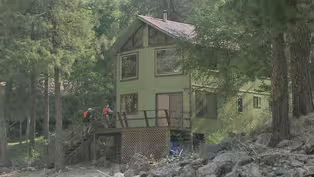
Travel by raft and jet boat down Main Salmon River to rustic lodges and other landmarks. (26m 47s)
Providing Support for PBS.org
Learn Moreabout PBS online sponsorshipNARRATOR: LAUREN MELINK With elevations as low as 1,300 feet, the Bitterroot Mountains boasts coastal flora and soaring cedar trees, then climbs above 10,000 feet, to showcase sharp ridges and alpine lakes.
In the summer, the landscape feels alive, birds chirp and mosquitoes buzz, wildlife roams, haze drifts between peaks and berry picking is abundant.
And in the winter, snow covered rocks sit stoic in the middle of icy rivers, frozen drifts, snow falling to make the sky match the hills.
There's ample space for adventure in the Bitterroot Mountains.
All it takes is a little williness to go out there and find it.
Funding for Outdoor Idaho is made possible by the Laura Moore Cunningham Foundation committed to fulfilling the Moore and Bettis family legacy of building the great state of Idaho, by the Friends of Idaho Public Television, by the Corporation for Public for Broadcasting.
MELINK: The Bitterroot Mountain Range runs more than 300 miles along Idaho's diagonal border.
And on one end of it you can see the range while riding on two wheels.
MATT SAWYER, ROUTE OF THE HIAWATHA: The Hiawatha identifies with the Bitterroots.
And this is the start of it from the top end.
This is the start of it.
MELINK: The Route of the Hiawatha is a former rail line.
It came about in the early 1900's when mid-west company, Milwaukie Road decided it was high time to expand westward.
A challenging feat, building a route through the Bitterroot Mountains.
SAWYER: When they were building all the tunnels, they would work from both sides and the engineers would try to sit there and make sure that they were working it correctly.
So you had a team on the Montana side, and a team on the far side, on the Idaho side, both digging through to come together and meet in the middle.
MELINK: The line was finished in 1909, and was about 200 million dollars over budget but within a year, a natural disaster would derail everything.
SAWYER: August, 1910, was called the Big Burn.
It was the largest fire in American history.
What was terrible about it is that it consumed three and a half million acres in the United States and one and a half million acres in Canada.
Unfortunately, the trail opened in 1909, in 1910, they had the fire and the railroad just watched what was their dream of harvesting all this lumber go up in smoke in three days.
MELINK: After that, the railroad had a series of bankruptcies, reorganizations and tried to reinvent itself again and again, until 1980 when the last train passed through.
Then, in 1998, the Bitterroot route reopened for another purpose.
SAWYER: Took the old railroad and those areas where the railroad used to exist, a beautiful pathway.
And you take out all of the rails themselves, where it buries the bones and, and turn it into a trail.
MELINK: Local business owner, Ali Koski and her two sons took a ride down the Route of the Hiawatha, 15 miles of railroad turned into a biking and hiking trail.
And for Ali, it was a first.
ALI KOSKI, WALLACE BUSINESS OWNER: I definitely did not expect the first tunnel to be as long and dark and wet as it was.
So I'm glad I had a light for that, and also glad I had a change of clothes, but they were beautiful and so like, cool in temperature.
So it was nice to go from the bright sun to the dark tunnels and have that variation on the trail.
SAWYER: There's 10 tunnels, nine that you ride through.
And then there are seven sky high trestles.
And the first tunnel here is 1.661 miles long.
That's our longest tunnel.
It's the second longest tunnel on the whole path of the Hiawatha.
ZEPH WILSON, RIDER: They were just pitch black.
Some tunnels were really short and you didn't really need a light, but the one right there was a mile and a half long.
So you needed a light.
BENNETT: Went through the last tunnel.
It gets really wet in there and there's just lots of mud.
And I decided to just full speed through this one this time and that just got mud all over.
KOSKI: The tunnels and the trellises were both really amazing.
But what I didn't expect were like the little pockets that you could kind of detour off on and turn it into like a whole day trip.
So you could walk down to the creek or walk up to the trestles and just see little pockets that weren't so common SAWYER: Last year, had about 70,000 people ride the trail.
In most seasons we'll have 60 different countries represented and all 50 states and the numerous areas from Canada.
BENNETT: It's weird to think.
I live not even 30 minutes away and there's people from all over the U.S.
that come here just for this trail.
SAWYER: There are some really rough areas of terrain along the Bitterroots and that's something that makes it special.
I think people come to get away and to enjoy this scenic nature and maybe the quietness and know that their phone's not gonna be ringing and things like that.
So to me, the Bitterroots is kind of a definition of space.
It separates Idaho and Montana.
SAWYER: They are a little bit rugged and they're pretty steep.
The elk, the deer, the flora, the fauna, all kind of comes together.
KOSKI: And I think that people take a lot of pride in it being like our own little corner of the Bitterroot mountains.
And so knowing that it's affiliated with the greater chain, it just is exciting to me to learn that there might be more if I kept traveling down and get to see more that Idaho has to offer.
MELINK: Depending on who you are, biking the Bitterroots can look very different.
LANCE GINES, INTO THE HORIZON ADVENTURE MOTORCYCLE TOURS: My name's Lance Gines.
I'm the owner of Into the Horizon Adventure Motorcycle Tours and Rentals in Boise, Idaho.
This segment of motorcycling is called adventure touring.
And so we're riding big dual sport motorcycles.
And so we pack all of our gear for doing seven to nine day tours and camp off of the motorcycles.
MELINK: In this case, Lance and his crew are tackling the Magruder Corridor.
101 miles of undeveloped dirt road that separates the Frank Church Wilderness from the Selway-Bitterroot Wilderness.
From Elk City, Idaho to Darby Montana, the road winds through a primitive landscape.
GINES: Roads like the Magruder Corridor, to me is really the iconic adventure touring road of any roads that I've ridden anywhere in the world because it's difficult, but it's not too difficult.
It's not the type that's gonna be like, "Oh my gosh, this is too much.
I'm not gonna ride this."
You just really kind of enjoy it.
DAVID YUNKER, ADVENTURE RIDER: For me, like father time is, is ticking away.
So I'm 64 this year and you know, this level of adventure writing, there's a certain amount of physicality.
And I can't do this forever, so I need to do it now.
BILL BLODGETT, ADVENTURE RIDER: So I think it's a way for us to kind of get back to our wild nature, there's something that about people that I think causes them to seek out adventure and obviously it's also a way to get away.
You know, you get, so many people in the city kind of wrapped up in the rat race and you need a break, you need some downtime.
GINES: It doesn't take very long on a motorcycle trip for people to really become good friends.
Because we all have to help each other out, and work together.
We work as a team.
MELINK: The Magruder Corridor has an interesting history.
It began as the Southern Nez Perce Trail, and over time trappers and traders began using it.
Then, in 1863, Lewiston merchant, Lloyd Magruder was returning from Montana when he was murdered by four men hired to protect his pack string.
GINES: To me, it's just part of the history of the west.
There was so much murder that went on back in the early mining days that this was just another one.
Back when I first started, the whole thing was very wooded.
Unfortunately, through wildfire, a fair amount of the Magruder has burned over the last 15 years or so.
But the experience has only changed.
Because the different wildflowers that bloom every year that have been sprung because of the fires and stuff are pretty amazing.
Last year, the fireweed was just unbelievable.
The whole mountainsides going across here were purple and it was just, just absolutely beautiful.
GINES: The bear grass kind of looks like a very large Q-tip or something.
It's pretty spectacular for sure.
BLODGETT: It's going good.
It's been a good time.
You know, some rocky sections, some loose sections, but it's all good.
It's pretty epic.
You get up to these, you know, high mountain areas.
You got these incredible views you can see for, you know, hundreds of miles.
GINES: I mean, it's a little bit of everything, you know, as far as how mountainous country can be, you get a lot of everything in here.
GINES: And so I just really appreciate nature in all forms, I mean that's one of the reasons I love Idaho is it's so diverse and we see so many different landscapes all within a single day, you know, but this across here is pretty, pretty special and pretty unique.
MELINK: The outskirts of the Bitterroots can be just as rugged as the range itself are equally rugged, to the west lay the Selway Crags a granitic cluster of low-elevation mountains dotted with sparkling lakes.
MELINK: Hard to get to and hard to leave, this isolated landscape offers a sense of solace to its seemingly few visitors.
WILL DOERING, HIKER: Going up on those peaks is really spectacular and you can just see for miles in every direction.
It makes you feel unimaginably small.
And I think that's what is most important for me is just you feel so, so small underneath all of this, and I thought that was fantastic.
That's not something that I, I think you can get any other way.
AUDREY GABRIELLI, HIKER: There's a little bit more risk that you have to consider.
So stakes are a little higher, but the payoff and the views are unmatched.
MELINK: The Crags sit south of the Lochsa River and north of the Selway River, the steep mountains, boulder fields and dizzying drop offs make for a challenging off-trail hike.
DOERING: There's really not more than, you know, five feet of flat ground at a time.
Like at any time you were either going downhill or you are going uphill.
So, you know, something may only be a mile and a half away or less, but the amount of time that it actually takes you to get there between, you know, backtracking, you know, zigzagging down, climbing down stuff, climbing up stuff, trying to find a route where it's not just a sheer drop, thousand feet, whatever.
It takes a long time to get anywhere.
GABRIELLI: The mountains don't hold back.
They're super steep, lots of deep valleys, but then when you get down into the valleys they're pretty lush and there's streams, there's still snow melting.
It was awesome because we were scrambling across these rocks and then, look down and there's this plethora of grouse berries there.
So I think the trip took us a little bit longer than we had planned because we kept stopping and having berry breaks and, and that's totally fine.
Love it.
DOERING: You know, you see this mountain and you're like, I climbed down that and I climbed up this, and I actually went that far.
And you can see Montana from where you're standing.
MELINK: From Legend Lake to Legend Peak to views of Three Links Lake and Cove Lake and Fenn Mountain, hiking in the Selway Crags offers up 360 degree panoramas, and for those willing to get them, an alpine dip awaits at the end of the day.
GABRIELLI: You can't be at a lake like this and not jump in.
We decided the best way to kind of wake up after, you know, the post-hike sleepies is to go and jump in the lake.
It felt amazing.
And, yeah, wakes you up.
GABRIELLI: There's always a trade off when you're in nature.
Sometimes in order to get those views, you're gonna also have to battle your friendly neighborhood mosquitoes.
That was a challenge, but it's still totally worth it.
Just come prepared.
Wear your bug nets.
DOERING: I've always wanted to go backpacking.
I felt it was a little bourgeoisie maybe.
But I'm really grateful that I did, I pulled the trigger and this is the best place I possibly could have gone for my first time.
I mean, it's really, it's really spectacular out here.
MELINK: Now if you want the mountains but without the isolation, there's a place to go in the Bitterroots that'll give you just that.
R.J.HIGGINS, LOST TRAIL SKI AREA: Lost Trail has been around since 1938.
That was the first year that people started skiing up here on this pass.
It's right on the continental divide.
We're just on the west side of it.
And by being up that high, you get really good snow conditions and good moisture.
MELINK: One mile down the road from Lost Trail is Chief Joseph pass named for Chief Joseph of the Nez Perce Tribe.
Also, located on the Idaho-Montana border, the area has become a playground for winter enthusiasts.
BENJI SCHWARZ, BITTERROOT CROSS-COUNTRY SKI CLUB: Chief Joseph pass is a free cross country ski area.
We operate off of grant funding and donations.
That's managed by the club as well as in a partnership with the forest service and then that contracts out with Lost Trail across the way.
SCHWARZ: Most people that are willing to come out this far are out to just kind of enjoy the day.
And it seems like there's a lot less tension and conflict when you get a little more space to yourself.
Today we were skate skiing.
It's just been kind of a hobby that you can carry on into any stage of life, just because it's so low impact.
And there's just something that gets addicting about moving that fast on snow.
But we do oscillate between this discipline and also the more traditional what we call classic skiing.
We have a good sampling of both those types of skiers up here at Chief Joe.
It's something a little bit meditative.
That kind of just bringing all of your attention because you are moving so fast and I mean, if you look at these things there, there's not much there to stand on.
Just the requirements for balance and flow.
And when you start to hear the snow kind of crunch under there, it kind of dampens out all the sound and forces you to focus.
It just forces you to just kind of come into yourself and it just really restores your peace, at least it does for me.
MELINK: With a mountain range splitting two states, the best way to access the grandest views of Idaho's Bitterroot Mountains is by climbing Montana's tallest Bitterroot mountain, Trapper Peak.
JEFF LONN, GEOLOGIST: We can see up the Bitterroot Valley all the way to Missoula really.
And we could see farther if it was not so hazy today, we could actually see all the way to the Mission Mountains.
You know, a hundred miles north of here, and we have the length of the Bitterroot range right here, and then all around us we have all these surrounding mountain ranges, the Pioneers and the Beaverheads in Southwestern Montana, the Bighorn Crags in Idaho.
And I think we could probably see the Selway Crags if I were to turn around.
Just a fantastic view.
MELINK: Over 10,000 feet, Trapper Peak rises above Montana's Bitterroot Valley, tempting seasoned hikers with its lofty summit.
While the top is certainly the destination, the journey to it is equally breathtaking.
LONN: There's hundreds and hundreds of alpine lakes in the area.
And of course they were scoured out by the glaciers and we went by a few on the way up and they're pretty spectacular places.
And they're usually separated by waterfalls because they're in hanging valleys that were created by the glaciers.
MELINK: As part of the Selway-Bitterroot Wilderness, Trapper Peak and the surrounding land have loyal defenders who believe in the value of the land - in its untouched state.
LONN: The wild lands aren't just important for us.
They're important for all the ecosystems, the plants and animals.
I think it's really important to preserve as much of it as we can.
And that seems to be getting harder and harder, but we keep trying to preserve things and we don't always win battles, but I think as someone said, it's not the battles that you lose that are so bad.
It's the battles that you don't fight.
MELINK: From the snowy peaks of the Bitterroot Mountains, comes runoff, destined for the Selway River.
ARI KOTLER, OUTFITTER, SOAR NORTHWEST: For me, as a river guide, as an outfitter on the rivers, the rivers are the arteries.
It's the life blood of any mountain range.
MELINK: The Selway is a 100-mile stretch of free flowing water that winds through pristine land that's only been tarnished by nature itself.
KOTLER: It's a place of solace.
It can also be a place of endorphins and rushes.
It's a protected and restricted river corridor, it transforms from one ecosystem to another.
Wildlife, greenery, so much, wildflowers.
It's hard to put into words, honestly.
MELINK: Rafting the Selway River feels remote.
And that's because it is.
Running through the heart of the Selway-Bitterroot Wilderness, isolation and serenity are common themes for those lucky enough to spend a few days here.
MANDY NUSSBAUM, RAFT GUEST: There's something really special about being able to sit and just have it be the natural world kind of enveloped in it.
Definitely a lot of like, you know, self thinking, being able to wake up in the morning and sit next to a campfire with a cup of coffee, just like in the quiet, hearing the rushing waters is really kind of incredible, as simple as it is.
KOTLER: And this feels good.
Something just resonates with them again.
It's like rekindling something that's lost in their heart.
MELINK: Tucked within Wilderness, the Selway River was uniquely protected in 1968 as a National Wild and Scenic River.
Only one raft group is allowed to launch each day and few permits are handed out each year.
ANDREW MOREHOUSE, RIVER GUIDE: I think it's amazing that people had the forethought to protect these landscapes.
And, um, I'm really grateful for that.
And, when you're out here, you understand, like this could look a lot different, if we didn't do that.
So I think wilderness is crucial.
This landscape has really steep canyons, rolling mountains, just that classic Idaho character of steep ups and, and downs and big canyon walls.
You know, you go through some, some older growth forests, some burnt forests, that I think lends itself to understanding the wild character of this landscape and the natural regime of the ecosystem.
KOTLER: You have your furs and your Pines, but you see outcroppings of your Northwestern, Cedar, we were spotting today and wildlife and birds.
JOHN BROWN, RIVER GUIDE: It's just incredibly lush, tons of cedars and yews and lovely little flowers everywhere.
It's also just frigging full of butterflies.
I've never been on any river outside of the tropics that had remotely this many butterflies.
MELINK: Whether you're a guide and you've seen it a dozen times, or a guest on your first Selway outing, the romance of this wild river is undeniably present.
BEN NUSSBAUM: I think it's important for us to have space where we can go and disconnect from the concrete jungles of society and enjoy the landscapes that humans were, you know, meant to enjoy.
It's been so amazing to watch the landscapes change so much since we first put in, in this really narrow, shallow river with pretty heavily wooded areas behind us.
And then today we went through like some really tight, narrow canyons with big rock walls around us.
It's just been so awesome to just watch it all go by.
It's like a never ending wallpaper out here.
[GUIDE: And forward two!)
MELINK: But make no mistake, the river's reputation as one of the best whitewater runs in the United States is well deserved.
BROWN: When the river is high, it's very big and very pushy and you have to be absolutely on your toes and really knowing how to navigate big, powerful white water and punch through big powerful features.
And then when it is low, there's a lot of rocks out there.
So it becomes just this technical tetris mind game.
KOTLER: The proximity of those rapids and the characteristics really define the Selway because at high flows, recovery space is minimal.
It's that Moose Juice, that crux right there after the confluence that gets people's hackles up.
You know, they want to make sure they understand the flows, know where they're at and have the best knowledge of what's to come, and the skillset.
BROWN: Just something about being out in the glory of this very big complicated thing, and having a great time by learning to play by mother nature's rules.
It's like that classic thing you play by the rules, you get to hang out at the party, you know, and it's an incredible party to get to hang out at.
MELINK: While whiteknuckled rapids might be what some people come for, what they leave with means so much more.
CHARLIE NUSSBAUM: Out in the quiet woods with my family, enjoying time together, and also just enjoying time doing things together, maybe just as importantly or perhaps more so, KEITH NUSSBAUM: It's been obviously the craziest rafting I've ever done and like the most exciting, but also very relaxing at the same time.
Because like the water feels great and the company is even better and then just, yeah, it's just, there's nothing quite like it, nothing quite like having your problems just flow down the river with you.
MANDY NUSSBAUM: It's been so fun and so silly.
Like everyone's just having a great time fishing or hiking or just riding along in the boats.
And it's just been laughing, sit around the campfire at night.
It's just, yeah, it's been a dream.
KOTLER: I've been on river time and then there's Selway river time.
It's just a different time and place.
That river sparkles green and you're swimming in it.
And you feel the sand in between your toes and watch that river go by, iIt's very magical.
It's sacred.
It just gets in your heart.
It gets in your soul.
It inspires you.
It takes you to different place.
The Bitterroot Mountains, the Selway River, you know, you've got to feel it to understand it.
You've got to live it to understand it.
Funding for Outdoor Idaho is made possible by the Laura Moore Cunningham Foundation committed to fulfilling the Moore and Bettis family legacy of building the great state of Idaho, by the Friends of Idaho Public Television, by the Corporation for Public for Broadcasting.
To find more information about these shows visit us at:
 New Episode
- Science and Nature

Explore scientific discoveries on television's most acclaimed science documentary series.



 New Season







Support for PBS provided by:
Outdoor Idaho is a local public television program presented by IdahoPTV
Major Funding by the Laura Moore Cunningham Foundation. Additional Funding by the Corporation for Public Broadcasting and the Friends of Idaho Public Television.