
How The Formation of Pangea Changed The World | Life and Death on Pangea
Seed plants and amniotes adapt to dry climates, helping them thrive on Pangea in the Permian Period.
From
How The Formation of Pangea Changed The World | Life and Death on Pangea
Season 9 Episode 1 | 25m 37sVideo has Closed Captions
Seed plants and amniotes adapt to dry climates, helping them thrive on Pangea in the Permian Period.
In the Late Carboniferous Period, predatory amphibians and giant arthropods ruled the swamps. But ancient seed plants and amniotes were evolving adaptations to drier climates. These will help them thrive on Pangea in the Permian Period to come.
From
Problems playing video? | Closed Captioning Feedback
Problems playing video? | Closed Captioning Feedback
How The Formation of Pangea Changed The World | Life and Death on Pangea
Season 9 Episode 1 | 25m 37sVideo has Closed Captions
In the Late Carboniferous Period, predatory amphibians and giant arthropods ruled the swamps. But ancient seed plants and amniotes were evolving adaptations to drier climates. These will help them thrive on Pangea in the Permian Period to come.
From
Problems playing video? | Closed Captioning Feedback
Where to Watch Eons
Eons is available to stream on pbs.org and the PBS app.
Related to This Episode
Welcome to Eons!
Join hosts Michelle Barboza-Ramirez, Kallie Moore, and Blake de Pastino as they take you on a journey through the history of life on Earth. From the dawn of life in the Archaean Eon through the Mesozoic Era — the so-called “Age of Dinosaurs” -- right up to the end of the most recent Ice Age.Providing Support for PBS.org
Learn Moreabout PBS online sponsorship252 million years ago, in the dying days of the Permian Period, life on Earth was brought to its knees.
♪ In the northern reaches of the supercontinent Pangea in what's now Siberia, colossal volcanic eruptions burst through the planet's crust, and they didn't stop erupting for hundreds of thousands of years.
An area nearly the size of Western Europe was blanketed in lava, and the knock-on effects of these eruptions baked the planet into a hellscape that, for most of the species of the Permian, was not survivable.
Blake de Pastino: On land, relentless heat, drought, and acid rain collapsed whole ecosystems and scorched the straggling survivors.
More than 70% of terrestrial species were lost forever.
Life in the oceans was devastated, too, as the water rapidly heated, acidified, and was stripped of its oxygen.
Over 80% of all marine species went extinct in an evolutionary blink of an eye.
Michelle Barboza-Ramirez: An entire ancient world of diverse living creatures was brought to a sudden and brutal end by this event, a catastrophe known in the study of deep time simply as the Great Dying.
The Great Dying was the single worst mass extinction in the entire history of life on Earth, a level of death that has no known equal in the fossil record, even more severe than the asteroid impact that ended the reign of the dinosaurs.
It was perhaps the closest that complex life ever came to being extinguished altogether.
♪ Gabriel-Philip Santos: But what really made the Great Dying at the end of the Permian such a disaster was that in the Permian Period itself, life had been thriving in ways that it had never thrived before.
The Permian was a chapter when ancient life on Earth conquered new realms for the first time, faced and overcame new ecological challenges, and pioneered entirely new ways of living.
These species rose and fell long before the first blade of grass sprouted, the first dinosaur hatched, or the first flower bloomed.
And the vastness of time that separates us makes them seem both strange and familiar to our eyes.
Kallie Moore: But the story of their evolutionary ascent and, in particular, of their catastrophic fall is one of the most important and dramatic in all of natural history-- a story about how a chain of geological, climatic, and evolutionary events erased an ancient world and created the modern one we know today.
And it's a story about us.
Our direct ancestors were shaped by the Permian and somehow survived the disastrous way that it ended, when few other species could.
But to understand the full story of the time that almost everything died, we'd have to start tens of millions of years earlier, before the Permian Period even began, in an ancient swampy forest here, in what's now Joggins, Nova Scotia, at a time when planet Earth would have looked... oddly familiar.
♪ ♪ The history of complex life on Earth is split into three main eras, each composed of multiple periods of time.
Currently, we're in the Cenozoic Era, or the era of recent life, the heyday of flowering plants, birds, and mammals.
In fact, you might also sometimes hear the Cenozoic Era simply called the "age of mammals."
Before that was the Mesozoic, or life's middle era, famous for its dinosaurs, and so sometimes called the "age of reptiles."
And even further back was the Paleozoic, the era of ancient life, when species were far older and stranger and rarely got the attention they deserve.
Now, the final chapter of the Paleozoic was the Permian Period.
It was brought to a close by the Great Dying, and it began with the formation of the supercontinent Pangea.
We'll get back to that a little later, but to set the scene, let's rewind just a bit further to the end of the period, just before the Permian, the Carboniferous Period.
While the Paleozoic seems so far in the distant past that Earth would barely be recognizable, at first glance, the resemblance would actually be pretty uncanny at times.
Because the way our planet looks now, blue, green, and white is actually pretty rare for Earth.
And the last time it had that classic Earth look was during the Late Paleozoic Ice Age, when the planet had glacial ice covering large areas of land, as it does now.
And for most of that ice age, the world even had distinct continents, like it does today.
The supercontinent of Pangea, on which the story of the Permian would play out, had yet to fully form, though it would soon enough.
It's hard to imagine our world looking any different, but this combination of features is an unusual occurrence from a deep time perspective, and a connection we share with those ancient days of the planet's history.
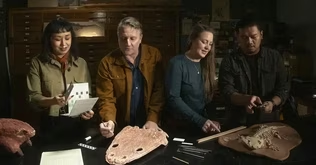
♪ For the last few days, we've been here in Boston at the Museum of Comparative Zoology in... [Imitates Boston accent] Harvard.
[In regular voice] Sorry, Boston.
It's been really fun, because I've been able to go into the collection and see some really amazing fossils.
It was this museum kid's dream come true to be in there.
Yeah.
From the outside, it's like, "Oh, that's just another rock."
And then someone thought, "Oh, let me crack this thing open.
Oh, I wonder if there's anything inside."
And lo and behold, an early tetrapod from the Late Carboniferous.
At the peak of this ancient ice age, near the end of the Carboniferous Period, the world didn't just look geologically familiar, it had started to look ecologically familiar, too.
Christina Byrd: What we're looking at here are some plant fossils from the Carboniferous.
In particular, we're finding a lot of ferns.
Gabriel: See, while the world was in a rare deep freeze with huge glaciers covering much of the southern hemisphere, the area around the equator was covered in lush, humid tropical swamps and rainforests, teeming with complex life.
In earlier periods of the Paleozoic, complex life had been found only in the oceans, where it had originally evolved.
But eventually, plants and invertebrates colonized the land, and by the Carboniferous Period, we vertebrates had joined them, too.
Thanks to the head start that invertebrates got over us in moving onto land, though, the Carboniferous is often remembered as the golden age of giant bugs, like Arthropleura, for example, a nearly 2.5-meter long, 50-kilogram millipede relative that had few, if any, competitors or predators to worry about in the swamps of the Carboniferous.
And ruling the skies was Meganeura, a pigeon-sized dragonfly relative, and one of the largest known insects to ever fly.
The vertebrate invasion of land was still only in its earliest stages, and we couldn't yet challenge the dominance of the giant bugs.
But our arrival meant that the swampy equatorial wetlands of the Carboniferous were among the earliest ecosystems on land to broadly resemble the ones we have today, with those three groups-- plants, invertebrates, and vertebrates-- all coexisting and interacting as they have ever since.
Basically, back in the Carboniferous with things moving onto land and evolving onto land, we're seeing the start of what today's rainforests started as and what they will eventually become.
But these ecosystems had some big differences, too, because during the ancient ice age, life on land was still finding its feet.
♪ Kallie: So, where exactly are we?
We're at the Joggins Fossil Cliffs.
It's a UNESCO World Heritage Site.
And it's 15 kilometers of beach exposure that's the Late Carboniferous or Pennsylvanian.
And it's the best Carboniferous exposure in the world.
Kallie: I've wanted to go to Joggins for a very long time, because I really just love the Carboniferous.
When I was a kid, the very first fossils I collected were Carboniferous fossils.
I even collected little, tiny Crinoid stems from the playground gravel when I was in grade school.
And I still have them.
When we first pulled up for the very first shoot here, I was, like, shaking the back of the car, and I was just like, "Let me out, let me go see it."
You see, the stars of the Carboniferous fossil record are its plants, fossils that fuel the modern world as we know it today.
So, if we were able to go back 300 million years ago, what would it look like?
300 million years ago, Nova Scotia was located at the equator, so it was a tropical rainforest with a lot of rivers flowing through.
So, the best environment to think of today would be the Amazon rainforest.
Kallie: The swamps were dominated by towering club mosses, relatives of horsetails and ferns, all of which reproduced by using spores that needed to find their way to moisture to become fertilized and grow.
Spores were an ancient feature in these plants.
They'd been using them since their small and spongy ancestors first colonized the land.
And by the Carboniferous, they'd grown and diversified to create complex rainforests, which included giants like Lepidodendron that had evolved into a towering tree-like form over 50 meters tall.
Oh, my gosh, look.
It's quite big.
Holy smokes.
And it's in that thick sandstone layer there.
And then if we move over, there's a second stump.
There's another one!
These are visible in the cliffs for about three to four years, and then they weather out.
And because it's a forest, new stumps will be visible in different parts.
Kallie: Seeing the Lepidodendron tree stumps in the cliffs was pretty amazing.
We walked for quite some time, and everybody was kind of like, "Are we actually going to see any?"
And then all of a sudden, Dr.
Jade Atkins was like, "Oh, look.
There they are."
And everybody in the crew-- everybody was like [Gasps] "There they are, there they are."
Knowing that these trees would have been flooded and buried 305 million years ago or so, and here they are just eroding out of the coast today is really special.
So, we found a really cool fossil on the beach here.
Can you tell us what it is?
So, this would be part of a stump of one of those scale trees, so Lepidodendron or Sigillaria.
Cool.
Each hole here would be a secondary branch in life.
♪ Kallie: The carbon dioxide drawn down from the atmosphere and incorporated into these photosynthesizing swamp plants is what gives the Carboniferous its name, the coal-bearing age.
No, you can still see plant in it.
Yes.
Yes, in most of it, you can still see plant.
Kallie: As they died, they sank into the murky depths generation after generation, where the conditions kept them from decomposing.
And as the glaciers of the Late Paleozoic Ice Age waxed and waned, these coastal swamps and their drowned plant material were regularly submerged, when the melting ice raised sea levels.
This plant material then formed peat that was buried, and after enough time, heat, and pressure, eventually transformed into coal.
♪ The same vast coal deposits that we would eventually find, dig up, and burn to power the world were created here in the swamps of the Carboniferous Period over 300 million years ago.
♪ So, what was life like when the coal layer was first being laid down?
So, this was a really lovely time for animals that might breathe through their skin.
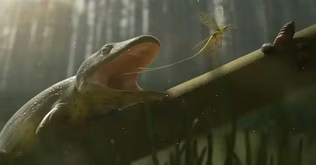
So, amphibians, but also insects were having a great time at this time.
Everybody was getting very big, and it was just a really moist rainforest environment.
That allows amphibians to be more widespread, because they are reliant on water to lay their gelatinous eggs.
They cannot lay them in a dry environment.
Kallie: One group of amphibious creatures called temnospondyls was especially widespread and abundant in these swamps.
Over the course of the Carboniferous, they flourished and diversified into a range of different sizes and ecological niches.
Some early temnospondyls were small and salamander-like, hunters of insects and other tiny prey in the forest undergrowth, like Dendrerpeton or "Tree-creeper," for example.
Dendrerpeton is one of the oldest members of a lineage that probably contains today's amphibians.
So, the frogs, salamanders, and caecilians that we know, this is one of their oldest known relatives, probably.
Kallie: Dendrerpeton is named for the way its fossils have often been found, preserved in the hollowed-out stumps of swamp trees that individuals crawled into only to become trapped and buried.
Others, like the big and powerful Eryops from the very end of the Carboniferous, were more crocodile-like.
What is that?
This is Eryops megacephalus.
Now, Eryops first evolved in the Late Carboniferous, but it didn't really get to this kind of size until the Permian.
Kallie: The lush swamps of the Carboniferous were ideal for amphibians, and in their damp, waterlogged paradise, they thrived.
Some even began spending so much time on land that they became almost fully terrestrial, reliant on watery habitats for only one last big part of life-- reproduction.
But among both the plants and vertebrates of the Late Carboniferous, a revolution was underway.
New groups had arisen that could break their ties to water entirely.
Blake: I have spent my entire adult life in the American West, which I love.
And that means I've spent a lot of time hiking in the woods among pine trees and spruce and fir.
And over that time, I've become enamored with a particular tree, the Ponderosa pine.
Part of what I love about them is the scent that they produce a certain time of year.
I'll be out on a hike, and the woods smell like butterscotch and vanilla.
And whenever I smell that and I'm on a hike, I know that spring is coming.
♪ Alongside the ferns, horsetail relatives and club mosses of the swamps were another group of plants known scientifically as gymnosperms.
Rather than reproducing like those other plants did via spores, which are tiny naked reproductive cells exposed to the world, they had evolved seeds.
Today, I'm at the Montana Conservation Seedling Nursery, and I met a fellow named Benjamin Jones, whose title is Grower of Seeds.
And his job is to turn these little, tiny seeds into giant Ponderosa pine trees.
Benjamin Jones: At the nursery, we grow about a million seedlings a year for anything from wildfire rehabilitation to just increasing wildlife habitat.
And you've been working here how long?
18 years.
So, you personally are responsible for growing 18 million trees, give or take.
I'll take partial credit.
[Laughs] That's amazing.
You must be very proud.
Yeah.
So I understand you're going to put me to work today.
What are we going to be doing?
We're going to sow Ponderosa pine into a styro block using a shutter box.
Okay, while I'm doing this, explain to me, why are seeds so important?
Why are they so successful?
Seeds are sort of an all-inclusive package.
They contain their own nutrients, they have their own moisture content, and they will only germinate when conditions are ideal.
Having seeds had helped early seed plants gain an increasing foothold in parts of the rainforests over the course of the Carboniferous.
It allowed them to tolerate the occasional seasonal dry spell, while spore-producing plants struggled to reproduce.
And by the Late Carboniferous, some of the gymnosperms were beginning to look kind of like the ones we have today.
The earliest conifer trees had evolved by this time, with many of the same traits as today's species.
They were woody, with needle-like leaves that retain water, and cones containing seeds and pollen that rely less on water for reproduction.
These adaptations helped primitive conifers and other gymnosperms thrive in drier areas of forest, where they had an advantage.
But plants were not the only ones that had stumbled on this same general solution for surviving in drier environments.
♪ Michelle: Around that same time, vertebrates had given rise to a new group that evolved a similar trick of their own-- the amniotes, with their shelled eggs.
Unlike the naked, gelatinous eggs of their amphibious ancestors and cousins that had to hatch in an aquatic environment, these amniotic eggs provided a self-contained aquatic environment internally.
The embryo was encased in an outer shell and an amniotic membrane that protected the developing young, just like the seeds of gymnosperms.
When this trait first arose, it was just a weird reproductive ability, albeit a useful one in areas of forests that seasonally dried out.
Yet this bizarre and unusual trait would go down in deep time as one of the single most game-changing evolutionary innovations ever, because it was the final push needed for vertebrates to become fully terrestrial.
And it gave rise to one of the greatest animal dynasties the world ever saw-- the amniotes.
♪ So, amniotes lay eggs.
Mm-hmm.
What makes these eggs such a big deal in the grand story of life?
Eggs were basically a key innovation of amniotes, and it allowed amniotes to break their ties with water, so that they could reproduce on land and not have to rely on going back to the water, like amphibians do.
Gabriel: All living and extinct reptiles, birds, and mammals are amniotes.
And even though we mammals mostly don't lay eggs anymore, we've essentially internalized our amniotic egg, losing the shell but keeping the amniotic membrane that surrounds the offspring inside the mother, though this extension of the process wouldn't develop for more than another 100 million years.
These earliest amniotes in the Carboniferous are who every vertebrate that isn't a fish or an amphibian-- from humans to hummingbirds to humpback whales-- can trace our ancestry to.
The rise of eggs and seeds played out around the same time in similar places, and for similar reasons, too.
But they also have one more thing in common.
They've both left lasting legacies on the world ever since.
So, you would say, like, the egg is what led to the success of, like, amniotes through time?
I would definitely say the egg is one of the key things that allowed amniotes to become so successful.
And the egg definitely came before the chicken, then?
Well, that's still up for debate.
[Laughs] Gabriel: And among one lineage of amniotes, an event was about to take place that seemed subtle at first but had consequences that still define the modern world today-- one ancestral population branched into two.
Michelle: We don't know exactly how it happened.
Perhaps one group was cut off from another by an environmental barrier,, like a newly-formed river, setting them on different evolutionary journeys.
Or maybe one group changed their behavior, becoming active at a different time of day, a different level of the forest canopy, or hunting a different type of insect prey, eventually drifting apart from the other group ecologically.
But we do know that the early species from each side still looked pretty much identical at first glance.
Yet from one side of the family split would come all reptiles-- from crocodiles to turtles to snakes to dinosaurs, including birds.
And from the other side would eventually come all mammals-- from manatees to mammoths to bats and wombats to us.
During the Late Carboniferous, it was really hard to tell the difference between these two groups, and it wasn't until later on in their evolutionary history where we see the defining traits of these two groups starting to evolve.
Gabriel: Think of all the iconic differences between both sides of the family tree today-- our skin, our teeth, our behaviors, our diets.
At this point, none of these differences exist yet.
The only reason we can tell them apart is because their fossil skulls have some subtle differences in structure that had begun to distinguish the two sides from one another.
As we'll see over the course of the Permian to come, the changes in sauropsid and synapsid anatomy will eventually become clear as they continue on their parallel evolutionary journeys.
Kallie: So, by this time, egg-laying amniotes and seed plants, including gymnosperms, had independently developed similar solutions to the same problem in the same environments, reproducing during times when land became dry land.
And while they were only ecological side characters compared to their more water-reliant cousins in the Carboniferous swamps, that was all about to change.
As the Carboniferous drew to a close, those oddball seed- and egg-producing species found themselves in the right place at the right time, and with the right traits to rise to prominence as the Permian approached.
This opportunity came in the form of a sudden ecological shift around 305 million years ago, an event known as the Carboniferous Rainforest Collapse.
Blake: Just before the Carboniferous Period came to a close, the planet started to dry out and warm up, which reshaped ecosystems on land.
The big swampy rainforests of the equator began to break up into isolated pockets, giving way to drier and more open environments.
Forests of conifers and other seed plants began to spread, replacing the wet swamps that had been so prevalent before.
And big forests of seed plants, like conifers, have stuck around in much the same way ever since.
These forests provide habitats for countless species and represent one of the planet's major stores of carbon.
It's hard to imagine the world without them, but they might have stayed on the ecological margins if the Late Carboniferous had played out just a little differently.
Instead, they became a familiar feature of the modern world that we can trace directly back to a 300-million-year-old climate shift in the era of ancient life.
And we, too, can trace the story of our rise to the same climate shift, because it was also the moment that the two lineages of amniotes found themselves perfectly placed to move into the new drier niches that were now available.
So, as we start to move into the Permian, things start to get drier.
So, we start to move into an environment where amniotes-- so animals that have the water with them in their egg-- start to thrive, because they're not tied to water the way the amphibians are.
Those animals actually had an opportunity to grow and diversify into these new niches that were opening because the old systems were starting to fail with this change in climate.
And this led to a rapid diversification of amniotes into all sorts of shapes and sizes during the Permian.
And the Carboniferous Rainforest Collapse was just part of a longer-term trend in the Late Paleozoic climate that would suit both these groups.
The world was heating up, and the ice age was beginning to end.
Glaciers started to recede from the higher latitudes as the deep freeze ended, allowing species to spread from the fragments of the swamps into these new regions reclaimed from under the ice.
The Carboniferous had ended, and the Permian had begun hot and dry, and it would only become more so over time.
And it wasn't the only planetary-scale trend in the Early Permian shaping the evolution of life, and, quite literally, shaping the world itself.
The continents we know today had gradually been fused into one by plate tectonics-- the movement of chunks of the Earth's crust and mantle over geologic time.
By the Early Permian, these forces had created a single huge, continuous landmass--Pangea-- which literally means "all the lands."
Pangea had been hundreds of millions of years in the making, and on it would play out the final chapter of the Paleozoic Era.
A chapter that would begin with bands of ancient wanderers leaving the shrinking swamps of the equator to venture into the new habitats that Pangea had to offer-- ecological opportunities beyond count, open to any species adventurous and hardy enough to survive the journey.
But Pangea brought with it new challenges for life, too.
The ancient world's weather and climate entered a new phase-- one marked by intense seasonal extremes.
It's fair to say the way the Permian Period began-- with the collapse of the rainforest, the end of an ice age, and the formation of Pangea-- was pretty chaotic.
But as we'll see, it's nothing compared to the way the Permian will conclude, with the Great Dying and the end of the Paleozoic world.
♪ "Eons" "Life and Death on Pangea" is available on Amazon Prime video ♪
















Support for PBS provided by: