
First Peoples of Southern California Before 1775
6/11/2026 | 26m 45sVideo has Closed Captions
Learn how the First Peoples of Southern California lived before the American Revolution.
The First Peoples of Southern California before 1775 include the Payómkawichum, Cupa, Cahuilla, and Kumeyaay. Discover how they lived before contact in ways that were rich, scientific, and sophisticated. Before the American Revolution, their world was already changing. As European powers expanded, two histories unfolded on different paths. Their story is one of resilience and resistance.
Problems playing video? | Closed Captioning Feedback
Problems playing video? | Closed Captioning Feedback
Historic Places with Elsa Sevilla: California's History is a local public television program presented by KPBS
First Peoples of Southern California Before 1775
6/11/2026 | 26m 45sVideo has Closed Captions
The First Peoples of Southern California before 1775 include the Payómkawichum, Cupa, Cahuilla, and Kumeyaay. Discover how they lived before contact in ways that were rich, scientific, and sophisticated. Before the American Revolution, their world was already changing. As European powers expanded, two histories unfolded on different paths. Their story is one of resilience and resistance.
Problems playing video? | Closed Captioning Feedback
Where to Watch Historic Places with Elsa Sevilla: California's History
Historic Places with Elsa Sevilla: California's History is available to stream on pbs.org and the PBS app.
Providing Support for PBS.org
Learn Moreabout PBS online sponsorship♪♪♪ ♪♪♪ Elsa Sevilla: Our region is rooted in the first people of the Kumeyaay nation who have lived here for millennia.
But change was coming to their traditional territory.
Hello, I'm Elsa Sevilla, welcome to "Historic Places" where we document and share the region's history.
As we lead up to the American Revolution, what was happening here in San Diego and on the East Coast may surprise you, both in the parallels and the differences.
Elsa: They are the first peoples of Southern California; the Payomkawichum, Kupa, Kawiya, and the Kumeyaay.
Before contact, they lived in clans and village-based extended families from the coast to the desert, guided by deep knowledge and tradition and living from the land.
We were invited into their traditional village and way of life, where ancestral lifeways are still preserved and thriving.
Lorraine Orosco: They were so intelligent and scientific about knowing what seasons were the harvest, what time of the year to move.
And we have evidence that they also put markers up for the time of the year so if the sun comes up in a certain place when you're standing on that marker, it'll tell you it's time to harvest.
Elsa: While each nation holds its own traditions, many methods are shared, from daily life to governance and spirituality.
Their beliefs are rooted in responsibility and respect, and it is carried forward through generations.
That same knowledge extends to the sky, guiding their celestial understanding and connection to the stars.
Lorraine: The moon, the sunrises, all those things and tying that to either ceremony, tying that to harvesting, tying that to basically our survival, and recognizing that this is our way of life.
Elsa: Leadership was collective, with families, clans, and village leaders working together in a system grounded in community voice and accountability.
They harvested, hunted, and fished.
Trade routes sustained daily life.
Ral Christman: So you have a leader who represents a family, a family leader or clan.
And they would meet with other family leaders.
They would represent a village or small community, and when they would all come together, you have the leadership who represented the people.
And so, today, we would describe that as representative government.
Today we would repres--we would describe that as a form of democracy.
And so, our people have been democratic since precolonial times.
Elsa: Culture, language, and traditions like bird songs, dances, and peon games carry their story forward through generations, preserving identity, history, and connection to the land.
Virginia Christman: I will continue and I see that it'll be carried through our culture, our traditions, our songs, our language.
Throughout our children and for the younger generations to carry it on so that it's not lost.
As we are Kumeyaay people, you know, we--it tells us who we are.
Elsa: For millennia this way of life sustained the first peoples of Southern California, rooted in balance, knowledge, and resilience that continues today.
It is not the past, it is who they are today.
They are still here and thriving.
[singing in native language] [singing in native language] Elsa: To learn more about the Kumeyaay Nation's history, Lorraine Orosco, education executive director, San Pasqual Band of Indians, and Kumeyaay Community College Board of Trustees, is here to talk more about this history.
Who are the Kumeyaay people in this region?
I think a lot of people don't realize the length of history of the Kumeyaay people, who are they?
Lorraine: So the Kumeyaay people are the first people of San Diego and Southern California.
We've been here for, our stories say time immemorial, and we are the descendants of the people.
Elsa: So how do you describe the territory, the traditional territory of the Kumeyaay Nation?
Lorraine: Currently are San Diego, up to the riverside, San Luis Rey River, and down to Ensenada, at the Bufadora, and we have stories on all these places.
Elsa: The Kumeyaay would sort of migrate or travel between the coast, the valley, the mountains, and the desert.
How do you describe this, and how did the Kumeyaay people survive and live off the land?
Lorraine: And migrated from the ocean to the mountains to the deserts.
And following the patterns of harvesting, animals and--there are, there are way too many--they're very important, all the native plants, very much so are so important.
And they were so intelligent and scientific about knowing what seasons were the harvest.
Elsa: I'm really interested in the cosmology and how they used the stars and how to travel, how to migrate, how to hunt and all those.
So how did they use the stars and the cosmology?
Lorraine: The sky was our calendar.
It was--it told us different things about what was happening.
We have names for the constellations, Kumeyaay, and what they meant to us.
And that has been passed down, luckily, that we do have elders that were able to pass down this information.
Elsa: As the Kumeyaay people thrived in balance, European powers were claiming territory across North America and beyond.
Along the east coast, new colonies seized land, setting in motion forces that would reshape entire regions as two worlds moved forward on very different paths.
male: You ride a little higher in the center.
Elsa: The first peoples of Southern California lived in harmony with the land pre-contact.
But across the Atlantic, powerful forces were building as European nations fought for power, wealth, and control.
They looked to the West to expand into what they called the New World, now North America, where indigenous nations had long been in their territories, stewarding the land for millennia.
Richard Carrico: Those wars, those conflicts, Protestant versus Catholic, all of those things that were being played out in Europe for hundreds of years are now going to manifest themselves in what was called the New World.
So each one of these people, each one of these cultures, these countries, for nationalism or for religion want to get over to the New World and claim it for themselves as soon as possible.
Elsa: European powers began encroaching across North America.
Spain invaded what is now Mexico in 1519.
The French encroached on what is now Canada in 1534.
And Spain later occupied what is now Florida in 1565.
The English occupied what is now Jamestown in 1607, and Plymouth in 1620.
Richard: So every European country with a navy, at least, France, England, Spain, Portugal, wanted their piece of the action.
If you are a Catholic nation, the Pope basically issued a bull, a bulletin saying you have the right to do this.
It is the divine right, what's called the right of discovery, so go forth.
Elsa: In 1542, Spanish ships arrived in Kumeyaay territory in what is now San Diego County in northern Baja California.
They came with soldiers and claimed the land for Spain, marking the beginning of outside intrusion on the West Coast.
Richard: Things got named here, on our continent, New England, Nueva España.
It's a New Spain.
It's a New England, New Bedford.
So in the British and the Spanish mind, this is just an extension of their relatively small countries, when you look at the territory they're all about to claim.
Elsa: Across both coasts, the impact followed a familiar pattern.
Diseases killed thousands, land was taken, indigenous nations were forced into new systems.
Spain sought control and assimilation while Britain pushed expansion and displacement to take indigenous territory.
Ethan Banegas: For us, it was simply slavery.
And we have--yes, we were allowed to leave sometimes, but not permanently.
Because if you were baptized, you were then property of the Spanish crown and you could not leave.
So, say an Indian was baptized and tried to leave permanently, the soldiers would come get him.
Elsa: These were not isolated events but part of a larger pattern unfolding across North America.
European empires were driven by competition, power, and greed, overtaking indigenous nations.
Change was already under way, reshaping their world long before the American Revolution began.
Elsa: With us is Richard Carrico, author and historian, who will talk about Spanish colonialism and the impact on San Diego.
What happens in the very first days, weeks of that expedition arriving in San Diego?
Richard: I always try to stress, you had two different agenda going on, if you will.
You had the military, which represented the crown and represented colonization and taking the land for the crown.
And then you had the Franciscan priest, in this case, Father Serra, and his goal and his motives are completely different.
His goal is to convert the tribes-- Elsa: Their religious goals.
Richard: To the religious goal.
And there was a lot of schism and a lot of fighting between the church and the crown and the military about funding, about who was in control of the tribes.
Elsa: So explain what was happening in Europe that initially started to create these migrations to North America.
Richard: Those wars, those conflicts, Protestant versus Catholic, all of those things that were being played out in Europe for hundreds of years are now going to manifest themselves in what was called the New World.
So each one of these people, each one of these cultures, these countries, for nationalism or for religion want to get over to the New World and claim it for themselves as soon as possible.
The Protestants, that we know more about from most of our American history books, at Jamestown and Roanoke and all of those places, again, they're not terribly interested in missionizing the tribes.
They want to control them and shove them out.
Versus on the West Coast and in Florida, the Spanish view, the Catholic view, is to bring the tribes in to convert them, mix with them.
There was no Spanish miscegenation law.
In fact, soldiers, and others, mercantilists, were encouraged to mate with local Native women.
That's how you're going to populate the world.
Elsa: What are some of those parallels between the East and West?
Richard: The military out here was trying to build forts.
They built four presidios to keep the Russians, who are moving in from the north, and potentially the British away from California.
So it's about nationalism, it's about conquering land.
It's about exploiting resources.
In Mexico, it was gold and silver.
On the East Coast, it's to build forts and towns, let's say the British, to keep the Dutch out, to keep the French out, to keep the Spanish, who had this long-going thing in Florida and the Southeast.
A lot of people don't realize how Spanish the Southeast was at one time, right?
Elsa: In the West, everything would change when the Spanish invaded Kumeyaay territory, bringing control, violence, and disruption to life, culture, and identity.
What followed was not just colonialization but a fight for survival, and the Kumeyaay resisted from the start.
Elsa: The Spanish arrived in Kumeyaay territory, what is now San Diego County in northern Baja California, in 1542.
But it would take another 227 years for them to return with soldiers and missionaries in 1769.
This time to stay.
They would build the first California mission and presidio in San Diego, marking the beginning of a system that would deeply disrupt life in the region.
Ethan: We're standing on a very special place for our people, and there was a village called Cosoy here.
And what it was really about was a freshwater spring, and that was really rare along the coast.
And it provided the Kumeyaay, as well as the Spanish, a fresh water source when they arrived.
Elsa: The village of Cosoy was at the foot of Presidio Hill near Old Town.
What followed was a mission system of control that reshaped daily life.
The Kumeyaay and other clans in the region were confined to imposed systems that restricted movement, replaced leadership, and enforced new ways of living.
Archaeological evidence from Mission San Diego and the Presidio reveals the toll malnutrition, forced labor, and lives disrupted under colonial rule.
Ethan: These bones showed signs of severe malnutrition.
These people were pushed constantly with no breaks, you know, similar to a prisoner of war camp.
Elsa: This was part of a broader global pattern as empires expanded and imposed control over land, people, and resources at the expense of indigenous nations in North America.
For the Kumeyaay and neighboring clans, the impact was immediate and devastating.
Ral: In that time, we lost so many of our storytellers and our elders that much of that story was lost.
So we spent so much time from then to now preserving what we have and also trying to reclaim what was once lost.
Elsa: But the first peoples, including the Kumeyaay, resisted from the start.
In 1775, the Kumeyaay burned Mission San Diego, an act of resistance against Spanish control.
The mission was destroyed but later rebuilt.
Spain would continue its expansion, eventually building 21 missions across California.
At the same time, resistance was rising across the continent.
In the East Coast, fighting began in Lexington and Concord in 1775, colonists seeking independence and self-rule.
Two struggles in the same year, same land.
One led to independence in the East, the other continued colonization in the West.
Lorraine: The Spanish wanted to spread the religion and have churches in different areas, and convert the Kumeyaay.
Elsa: As the American Revolution unfolded from 1775 to 1783, the first peoples of Southern California, including the Kumeyaay, continued fighting for survival, land, and identity.
Their resilience and adaptability continued to carry them forward.
[singing in native language] Elsa: Ethan Banegas, from the Barona Band of Kumeyaay Indians and professor at San Diego State University, is with us to talk about San Diego's history.
Ethan, can you tell us about the first encounter between the Kumeyaay people and the Europeans here in San Diego?
Was it peaceful?
Ethan: In April of 1769, Pedro Fages arrives, and it's a small amount of people.
His soldiers had scurvy, and they needed a fresh water supply.
Now, scurvy is a lack of vitamin C, so these folks had to quickly find nourishment, and the villagers of Cosoy provided that for them.
They--six miles away from Ballast Point to Cosoy, you had the Kumeyaay leaders lead the Spanish to this freshwater spring and essentially save their life.
So this is a very similar again to kind of what happened on the East Coast with the Wampanoag and the Pilgrims.
And we had an event just like that where there was this--really a beautiful sign of generosity that saved the Spanish and allowed them to settle here.
Elsa: You talked about the mission and the presidio next to the village of Cosoy.
What were things that were discovered there during the excavation?
I believe there were two excavations by San Diego State University.
Ethan: These bones showed signs of severe malnutrition.
These people were pushed constantly with no breaks, you know, similar to a prisoner of war camp.
And Sherburne Cook wrote a book in 17--1976 called "The Conflict Between White Civilization and the California Indian."
And in that book, using mission records, he uncovered that the San Diego Mission had the least caloric intake out of all the missions at 1,000 calories a day.
So for the kind of work they were doing at the mission, you would need at least 3,000 calories.
So they were deficient by at least 2,000 calories.
Elsa: By the early 1700s, colonial systems were firmly in place across North America.
In the East, British colonies continued to expand, while in the West, Spain built more missions, bringing a colonial system that would reshape traditional territories.
Land would be taken, resources extracted, and indigenous communities displaced.
Elsa: As the colonies moved towards independence in 1775, reshaping power in the East, life in the West followed a different path.
Spain expanded the mission system in California, tightening control over indigenous nations.
Missions were built about 30 miles apart, a one day journey, forming a network to control land and secure Spain's claim to the West, and block British and Russian expansion to the region.
The first mission and presidio were built in what is now Presidio Park near Old Town.
Richard: So we're on the site of the first mission, and I want to stress Alto, California, because there'd already been 18 or so in Baja California.
Right, and so Father Serra established it here, raised the cross, the soldiers claimed this for Spain, and-- Lorraine: They saw us differently, as barely surviving, and that they were going to save our souls and teach us a better way of life.
Which now, all these hundred years later, we know is not a better way of life.
Elsa: The Spanish mission system destroyed essential life, including trade routes and food systems the Kumeyaay and neighboring clans relied on.
As cattle trampled and consumed native resources, indigenous lifeways were systemically dismantled.
Across the region, land, leadership, and daily life were dramatically changed as territories were divided and renamed and traditional systems destroyed and replaced.
Lorraine: Our people were forced into labor to where their spines were compacted.
Their bone structures were deformed because of carrying brick, adobe, different things.
And having young lives, honestly, dying from disease.
Elsa: From the West Coast to the East Coast and beyond, the pattern remained the same.
Disruption, resistance, and survival as indigenous nations worked to protect and carry forward their identity while facing the spread of disease, the loss of traditions, and the breakdown of established ways of life.
Ral: And the elders of our community who are the ones who are our knowledge bearers, they're the ones who guided our community, they're the holders of our philosophy and of our ceremonies, when they passed on, we've seen a lot of our traditions pass as well.
Elsa: In California, as power shifted from Spain to Mexico, and later to the United States, encroachment across indigenous territories continued and conditions worsened.
Despite this, indigenous nations endured, resilient and adaptable, continuing to carry forward their identity and story.
Virginia: We started talking about the language, not only as a language, but the areas of the different places.
That--how I explained to them culturally was that Kumeyaay, Baja, extending all the way to the Pacific, you know, all within the area.
Elsa: For the first peoples of Southern California, this is not just the past, it is lived.
They are still here, thriving and preserving their story for the future.
[singing in native language] Elsa: Ral Christman from the Viejas Band of Kumeyaay Indians joins us to talk about this part of history.
Ral, thank you for being here.
Ral: Haawka, it's good to be here.
Elsa: And a lot of people look at the missions and they see that it's this beautiful story.
But for the Kumeyaay, for indigenous everywhere, it was a completely different story that a lot of people today don't know.
Ral: And it's a very beautiful tourist destination.
However, every one of those missions, including San Diego, if you look somewhere in the back, you'll find a grassy area and a little plaque, or something, saying that here lies X amount of Native peoples that were unceremoniously buried there.
Our people were kicked into a pit.
In that pit you'll find remains of Kumeyaay children that had shackles on, and the traces of that left on their bones.
Elsa: So there's evidence of all of this happening and you were able to discover this evidence?
Ral: This was discovered in the mid-80s.
And our people have been fighting since to uncover that truth and let it be broadcast, that people know that, yeah, it was not always a beautiful thing.
I know when I was in school, there was a time period where we were told the mission was a good thing.
And I know as a youth in California we're often told that the Natives enjoyed the mission.
It was a good thing that happened to us and we were happy to be there.
Unfortunately, that's not a true, that's not a truthful thing.
Elsa: The Kumeyaay have warriors, we don't hear about them as often.
Do--were the warriors the one that resisted the most, and were they part of the burning down Mission San Diego de Alcala?
Ral: At that time, warriors from that--those villages, they went down, and they burned down the mission.
And they pulled out the leadership, and they killed them.
And that wasn't done at a--they didn't do that just to go do that, they did that as a response.
They did that as a response to the stealing of our children and the rape of our women, and all the atrocities that have been committed towards our people.
So as war and attack and killing is a last means for our people, it is definitely something that we have, traditionally, have had to do.
Elsa: And what do you think is important for people to take away from the Kumeyaay territory, the Kumeyaay history and heritage?
For those who don't know it as well, what do you want people to take away from it?
Ral: We have thrived and we were able to do that by taking care of the land, having a common respect for one another, taking care of each other.
And I think a lot can be learned from that.
In these modern times we see ourselves polluting the earth, going to war with one another, but our people have been here for thousands of years and we're still here and we're going to still remain.
Elsa: Thanks for watching "Historic Places," where we document and share the region's history.
I'm Elsa Sevilla.
Until next time.
♪♪♪ ♪♪♪ ♪♪♪ ♪♪♪ female announcer: Support for this program comes from the KPBS Explore Local Content Fund, supporting new ideas and programs for San Diego.
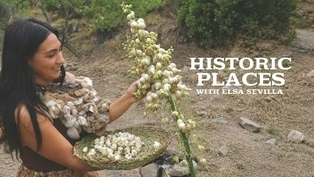
First Peoples of Southern California Preview
Video has Closed Captions
Coming 6/11 learn how the First Peoples of Southern California lived before the American Revolution. (30s)
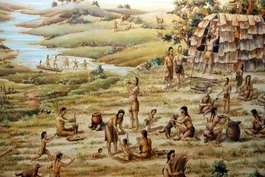
Video has Closed Captions
The First Peoples of Southern California face the beginning of colonization, marking a turning point (6m 32s)

Video has Closed Captions
The First Peoples of Southern California faced destruction of their territory and traditions. (6m 48s)
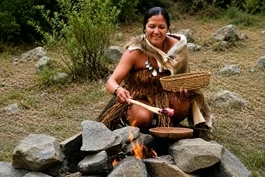
Video has Closed Captions
An intimate look at the First Peoples of Southern California before contact. (6m 35s)
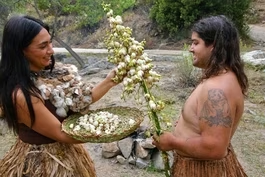
Video has Closed Captions
How encroachment of the Spanish brought profound destruction to the First People's lives. (6m 5s)
Providing Support for PBS.org
Learn Moreabout PBS online sponsorship












Support for PBS provided by:
Historic Places with Elsa Sevilla: California's History is a local public television program presented by KPBS